Growing
Turkey Tail (Trametes versicolor): The Most Scientifically Validated Medicinal Mushroom You Can Find in Your Backyard
Complete turkey tail mushroom guide covering Trametes versicolor identification, wild foraging and log cultivation, PSK and PSP polysaccharide chemistry.
On this page
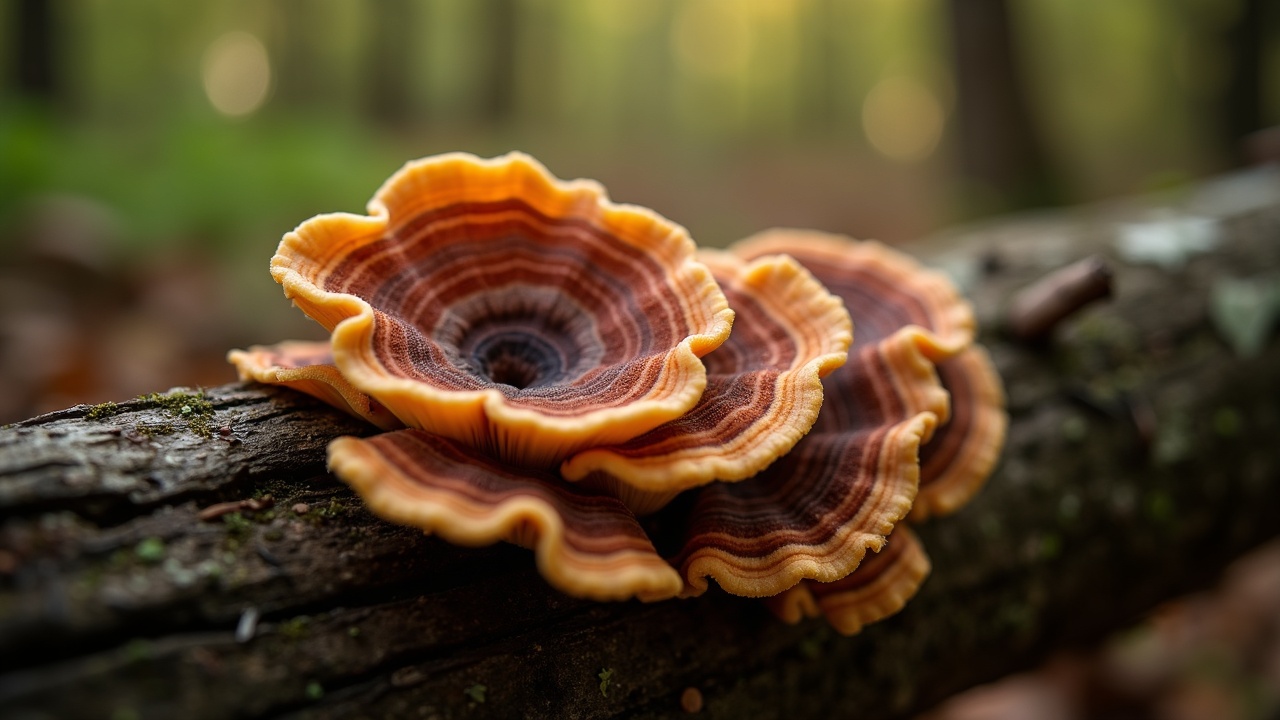
Turkey tail (Trametes versicolor) is one of the most common and recognizable bracket fungi in the world, found on dead and dying hardwood trees, stumps, and fallen logs across all temperate and many tropical regions. The fan-shaped fruiting bodies grow in overlapping clusters and display concentric zones of color in stunning patterns of brown, tan, cream, blue, green, and gray, resembling the fanned tail of a wild turkey. The pore surface underneath is white to cream with very fine pores (3–5 per millimeter).
Correct identification is important because several look-alike species exist. True turkey tail has: (1) concentric color zones, (2) a velvety to slightly fuzzy upper surface, (3) white pore surface (not smooth or gilled), and (4) thin, flexible fruiting bodies. The most common look-alike, Stereum ostrea (false turkey tail), has a smooth underside rather than pores.
Prescription Drug Status
Turkey tail holds a unique distinction among medicinal mushrooms: its polysaccharide extracts have been developed into prescription drugs. PSK (Krestin/polysaccharide-K) has been an approved cancer adjunct therapy in Japan since 1977, covered by Japanese national health insurance. PSP (polysaccharopeptide) holds similar status in China. Annual sales of PSK in Japan have exceeded $600 million. No other mushroom compound has achieved this level of pharmaceutical validation.