Plants
Dragon Fruit (Selenicereus undatus) Extraction Guide: Juice, Peel Pigment and Seed Oil
How to make dragon fruit juice, a peel pigment extract and seed oil, with the solvents, times and temperatures from published studies, what the evidence shows, and the cautions.
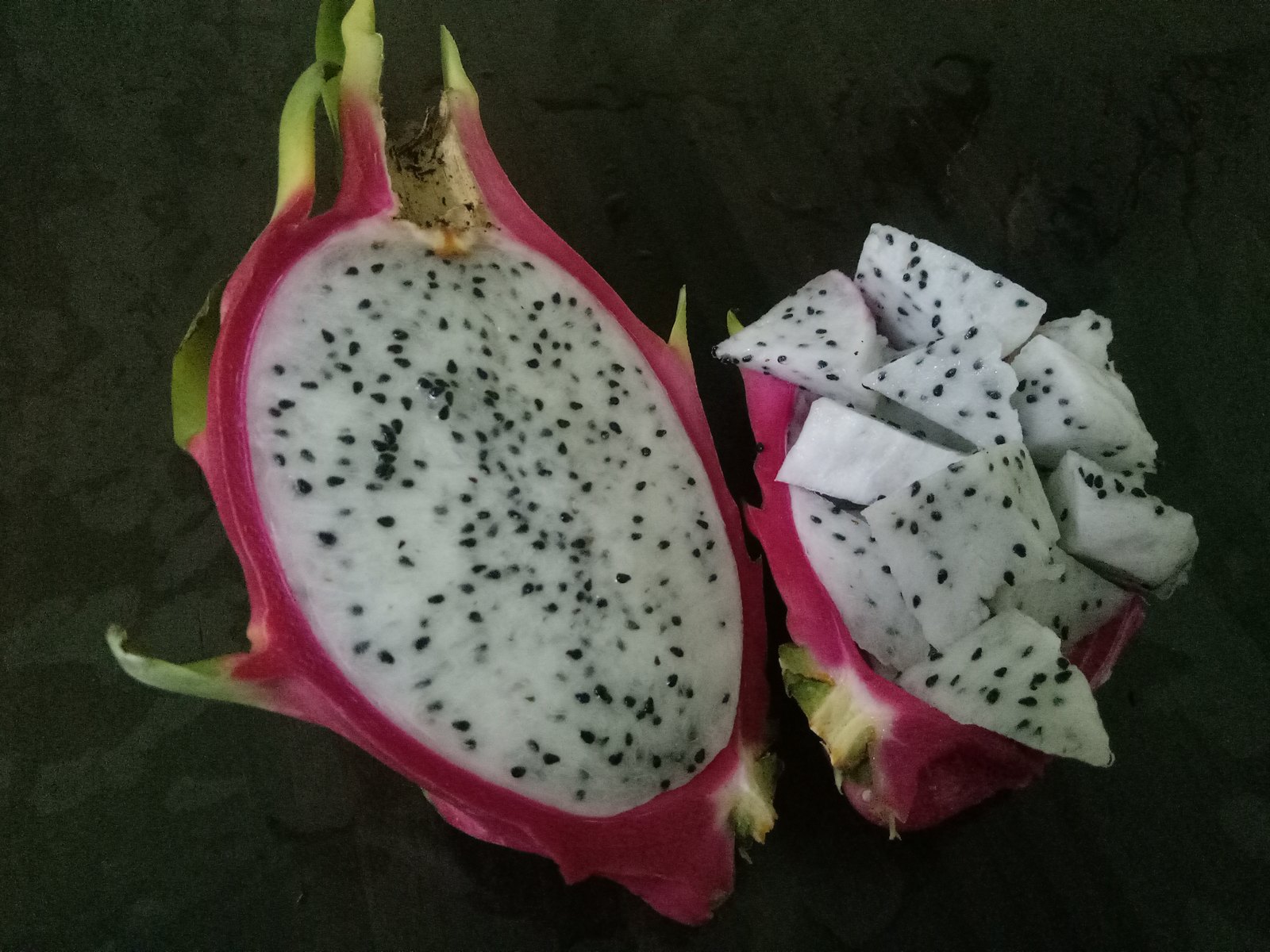
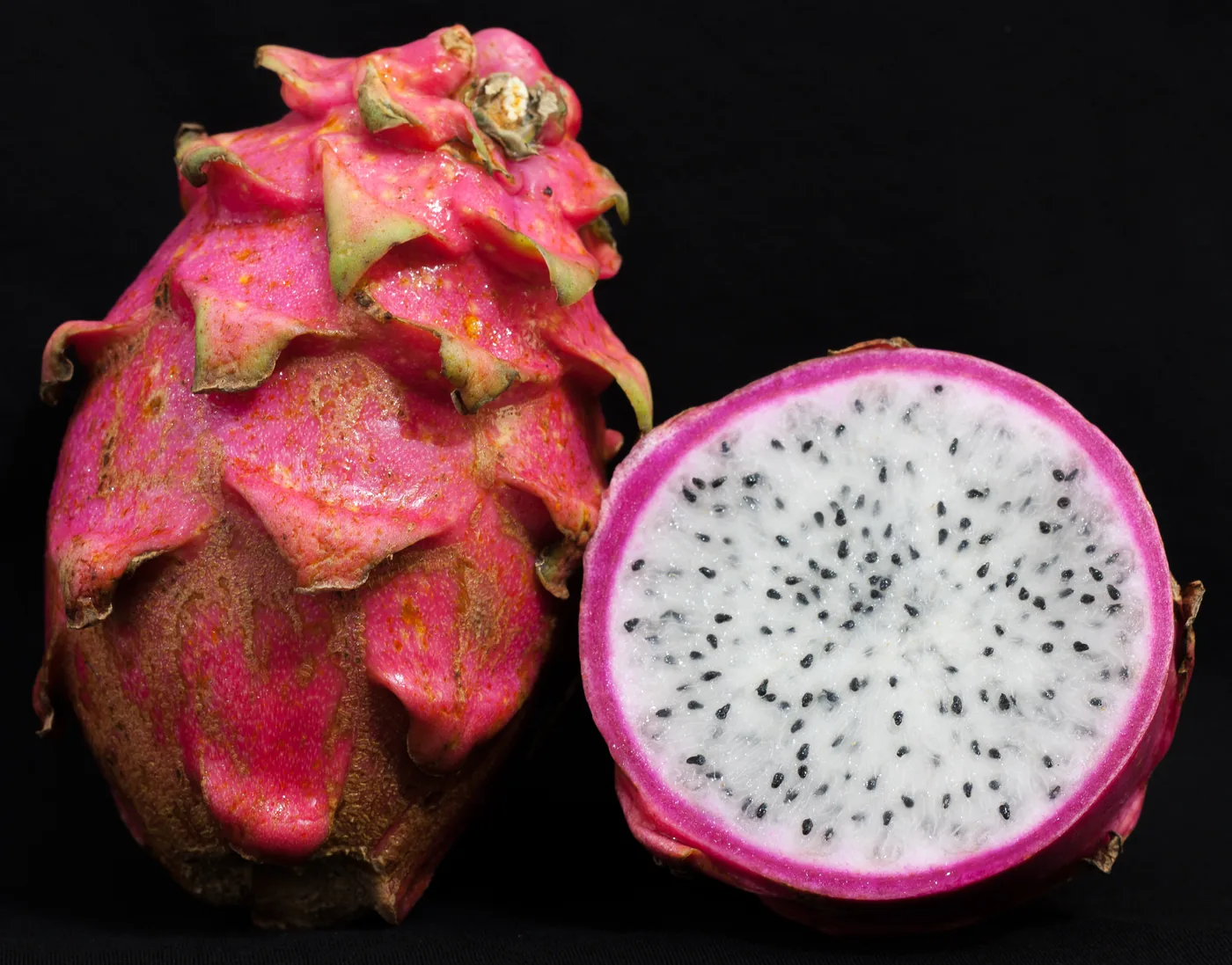
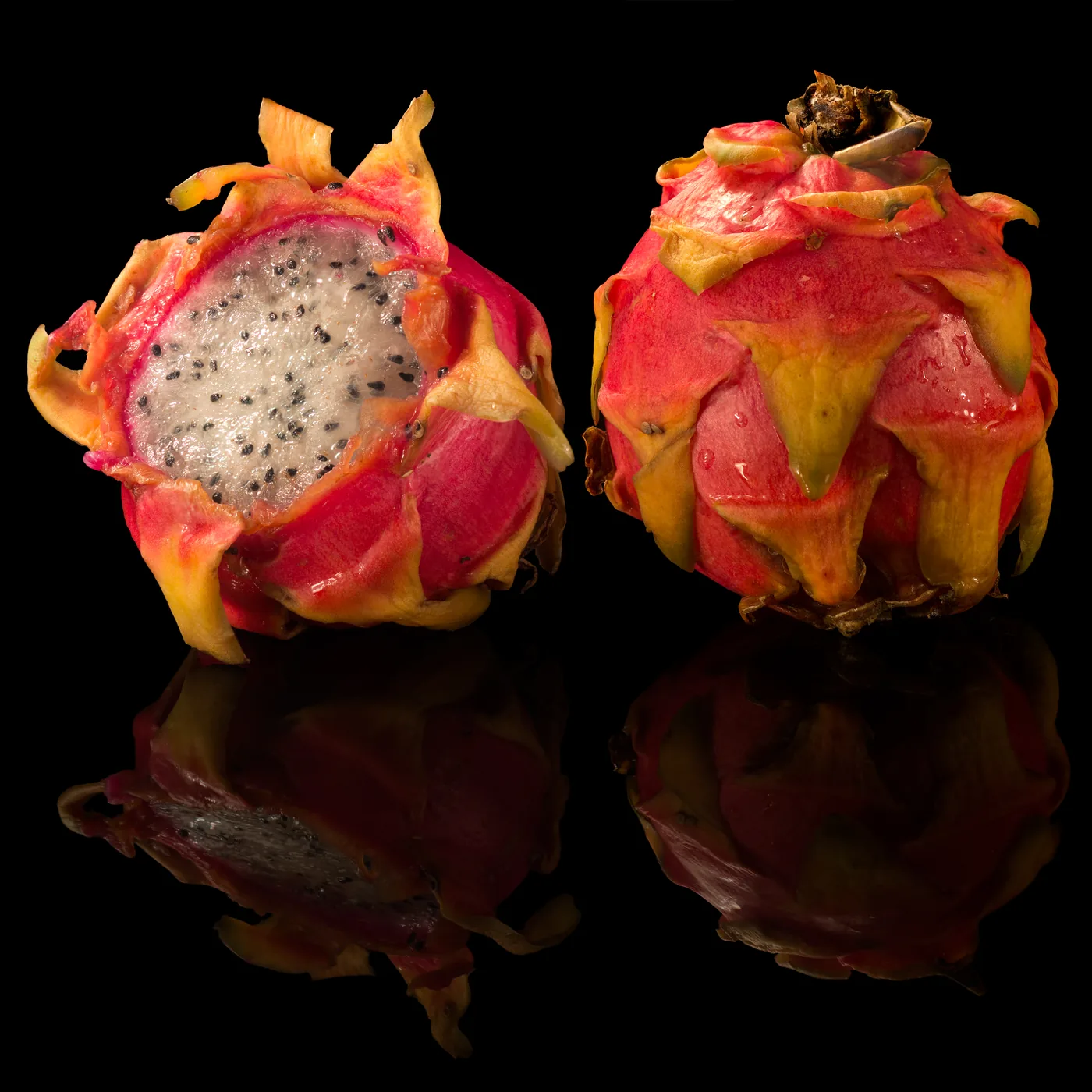
Photograph: Shyamal Kumar Chaudhary, CC BY-SA 4.0. Source: Wikimedia Commons

On this page
Introduction
A dragon fruit is mostly water, with a thin pigmented peel, a pulp full of tiny black seeds, and a few compounds that people have learned to pull out of each part. The best known is the red-violet pigment that colors the red-fleshed types, used as a natural food color. The seeds carry an oil, and the peel and pulp carry phenolic compounds, which are plant chemicals that act as antioxidants in a test tube.
This guide covers the white-fleshed species, Selenicereus undatus, and it says plainly what that species does and does not give you. We explain what the fruit holds, why red and white fruit behave so differently, how to dry and grind the peel, how to make a juice, a water extract and an alcohol extract, how pH and storage time change the color, what is known about the seed oil, the dose used in the one human trial we found, and the cautions that go with all of it.
Summary
- The pigment: white pulp of this species has been reported to hold no betacyanins, the red-violet pigments. In the red-fleshed fruit, pulp held more than 800 times as much, so the peel is the part to use from white fruit.
- Peel method from a study: slices 1 by 5 cm dried at 60 °C for 8 hours, ground through a 60 mesh sieve, then soaked 24 hours in the dark in 50 percent aqueous ethanol, 1 part powder to 10 parts liquid.
- Keep it out of strong acid: after 10 days at room temperature in the dark, a peel extract at pH 1 kept about 8.58 mg per 100 g of pigment, against about 17.00 at pH 3.
- Seed oil: cold pressing below 60 °C gave about 19.48 g of oil per 100 g of seeds, mostly linoleic and oleic acids.
- The human trial: 24 g a day of dragon fruit powder for 14 days improved a measure of blood vessel widening and left blood pressure unchanged.
- The cautions: allergy to the fruit has been reported, and one source says it may interact with blood pressure and blood sugar medicines.
Why does the species matter so much? Because most of the published work on pigment uses red-fleshed fruit, and a method that works on that fruit does not carry over to the white one without checking.
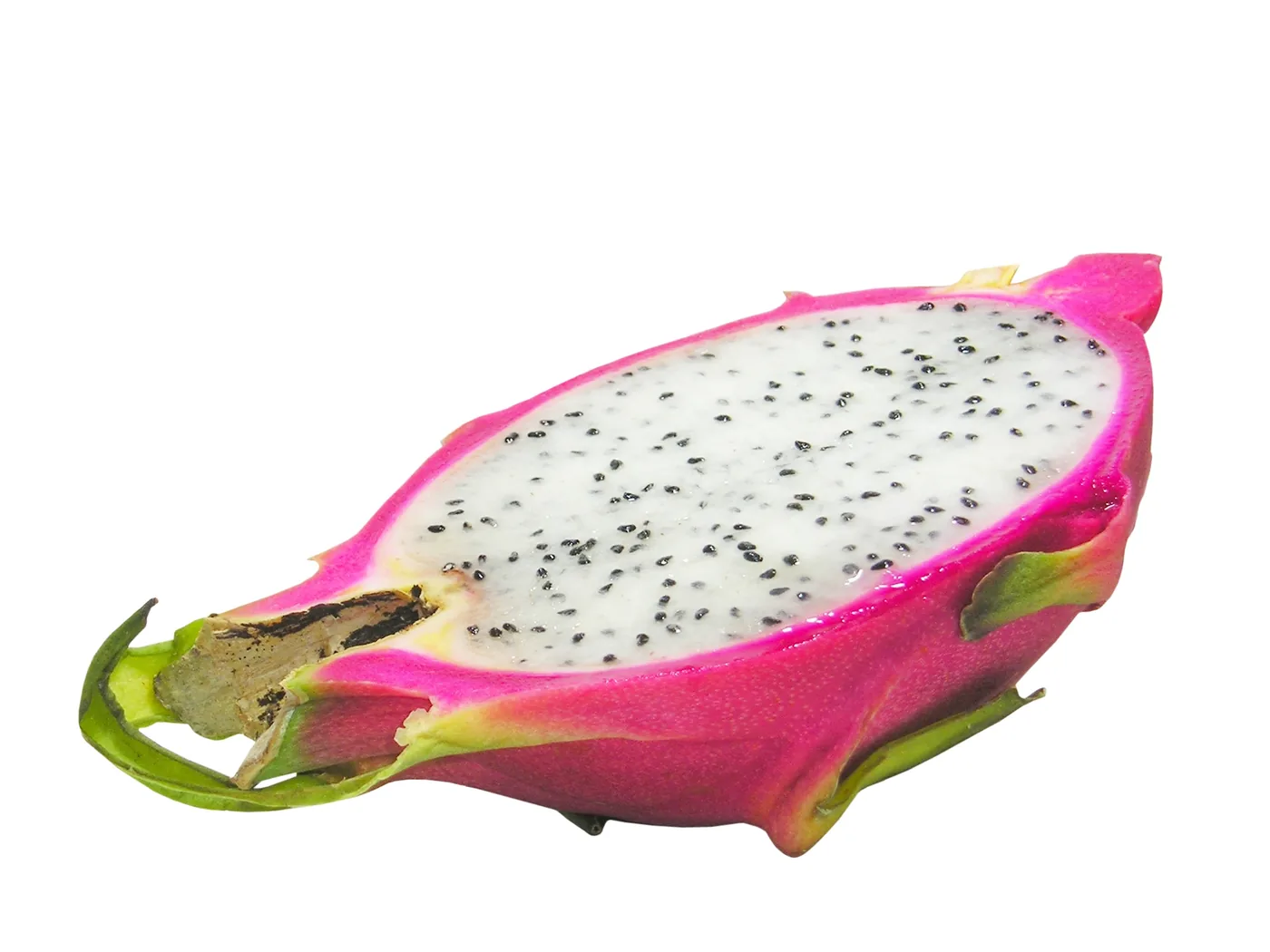

The grower's side of this plant, from rooting a cutting to harvesting the fruit, is on our partner website, and a link to it sits near the end of this guide.
What the Fruit Holds
Per 100 grams of raw fruit, the pulp is about 84 g water, 15.2 g carbohydrate (9.75 g of it sugar and 3.1 g fiber), 0.36 g protein and 0.14 g fat, and it supplies 57 kcal. That water content is the first fact to design around, because a fruit that is 84 percent water spoils fast and has to be dried or frozen before you can store it.
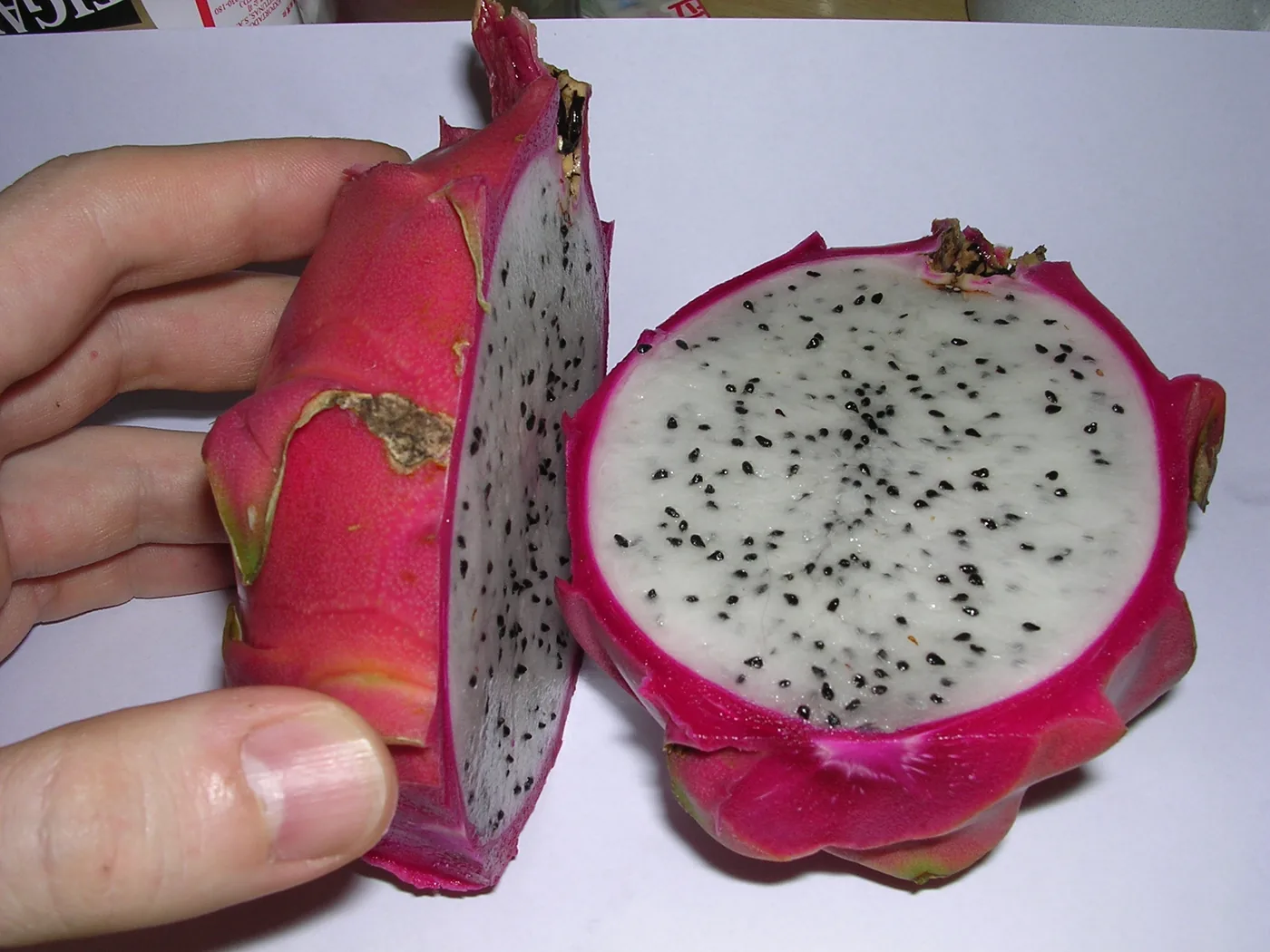

Beyond the water, three groups of compounds interest people who make extracts.
- Betalains: the red-violet pigments, called betacyanins, that include betanin, the same pigment found in beets. They dissolve in water.
- Phenolic compounds: a review of 57 studies found flavonoids to be the main class in both pulp and peel, with kaempferol and rutin the most prominent, along with chlorogenic, caffeic, protocatechuic and ellagic acids.
- Seed oil: the small black seeds hold oil, which is rich in linoleic acid.
Those groups are not spread evenly through the fruit. The next section sorts out which part holds what.
How to Choose an Extraction Method for Any Herb
Match the method to the plant: what polarity and heat sensitivity mean, and which solvent pulls out which compounds.
For a More In-Depth Read, Click HereWhite Fruit and Red Fruit
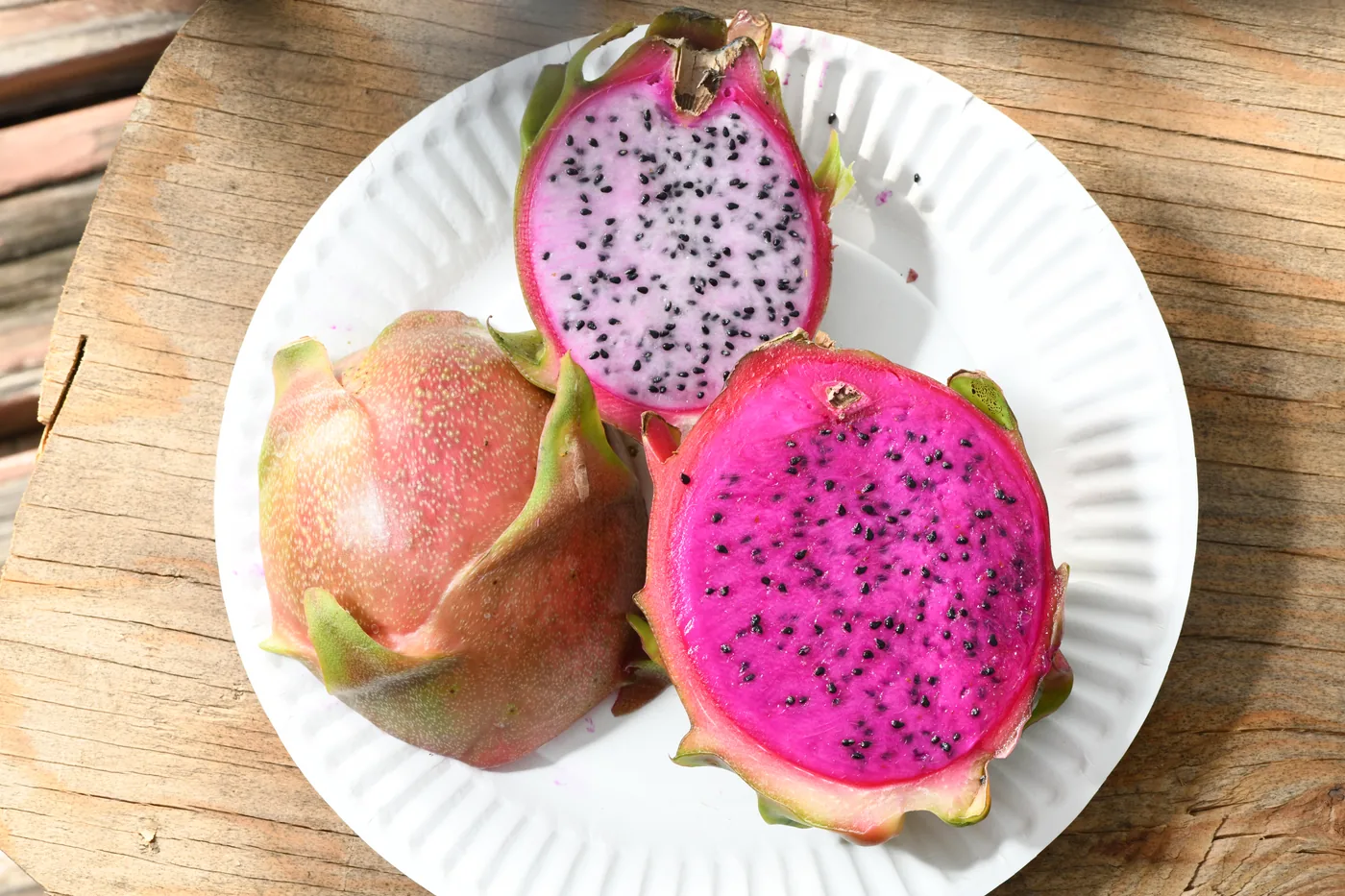
Dragon fruit comes in three common kinds. Selenicereus undatus has pink skin and white flesh, Selenicereus costaricensis has red skin and red flesh, and Selenicereus megalanthus has yellow skin and white flesh. Red and purple colors in the fruit come from betacyanins.
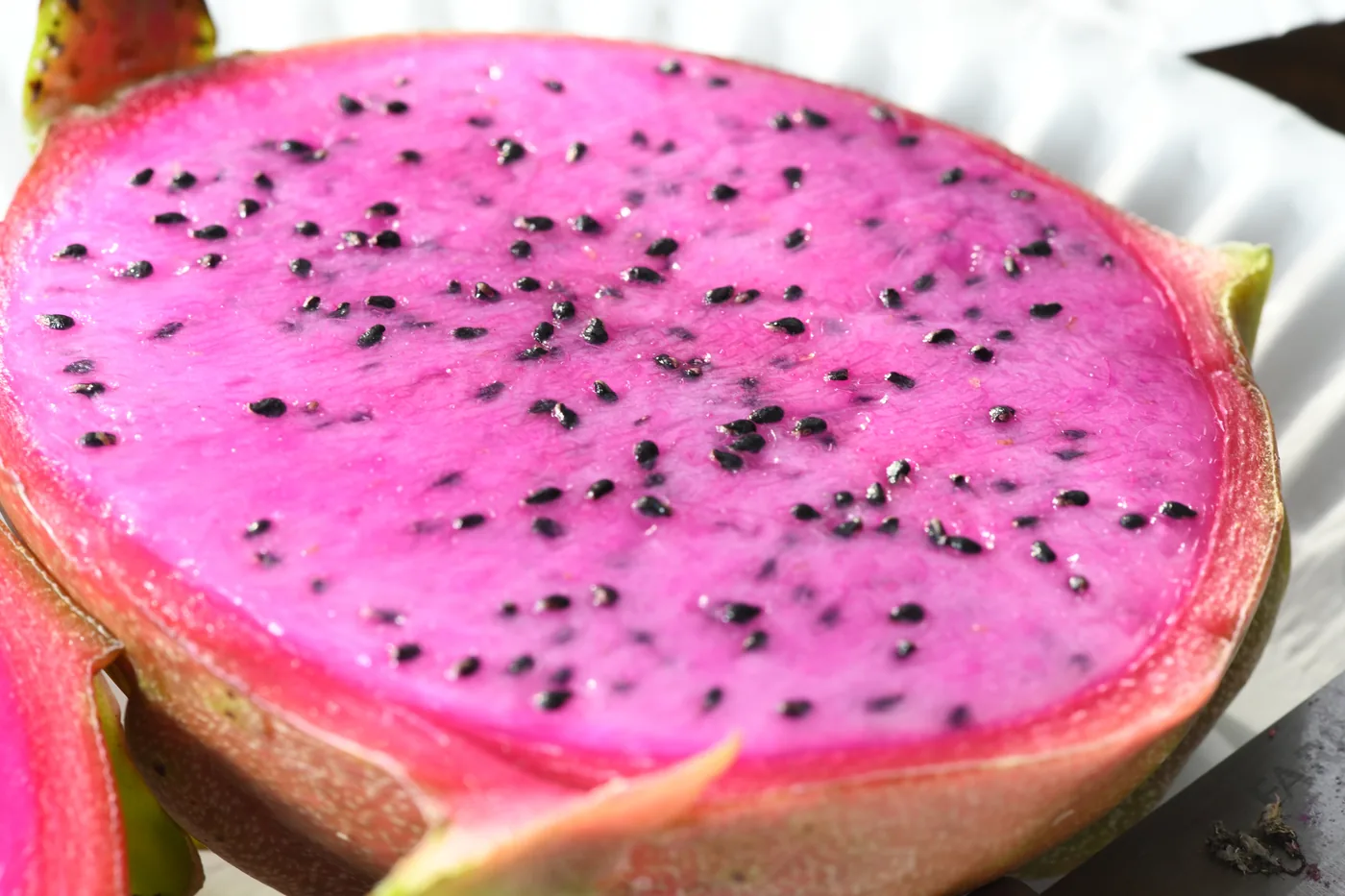

Here is what that means for white-fleshed fruit. A review of the pitaya color literature says white pulp of this species has been reported to contain no betacyanins and no betaxanthins, the yellow cousins of the red pigments. The same author notes that red-fleshed pulp held more than 800 times the total betacyanins of white pulp, and red-fleshed peel more than 5 times that of white peel. No units were given for those ratios, but the direction is clear.
One other group did report betalains in white pulp, and the review author disputes that data as inconsistent with the biology. We treat the white pulp as a poor pigment source, and we note that the peel of white fruit is where a pigment extract makes sense.
If your goal is a deep red color, choose red-fleshed fruit. If you grow or buy the white type, you will get a mild, mostly clear juice from the pulp, a pink-tinged extract from the peel, and an oil from the seeds.
Choosing a Method
Which method suits which part? The studies we found gave details for peel and pulp pigment, for seed oil, and for an industrial peel extraction, and juicing adds two more routes. Each differs in solvent, time and equipment.
The choice starts with the compounds, not the equipment. Most of what this fruit holds is water-loving: the betalains in the peel and the pulp, and the pectin in the peel wall. The flavonoids sit in the middle, and only the seed oil and the peel waxes are oily. So the routes below lead with water and watery ethanol, and a nonpolar solvent or a press is kept for the seed oil and the waxes.
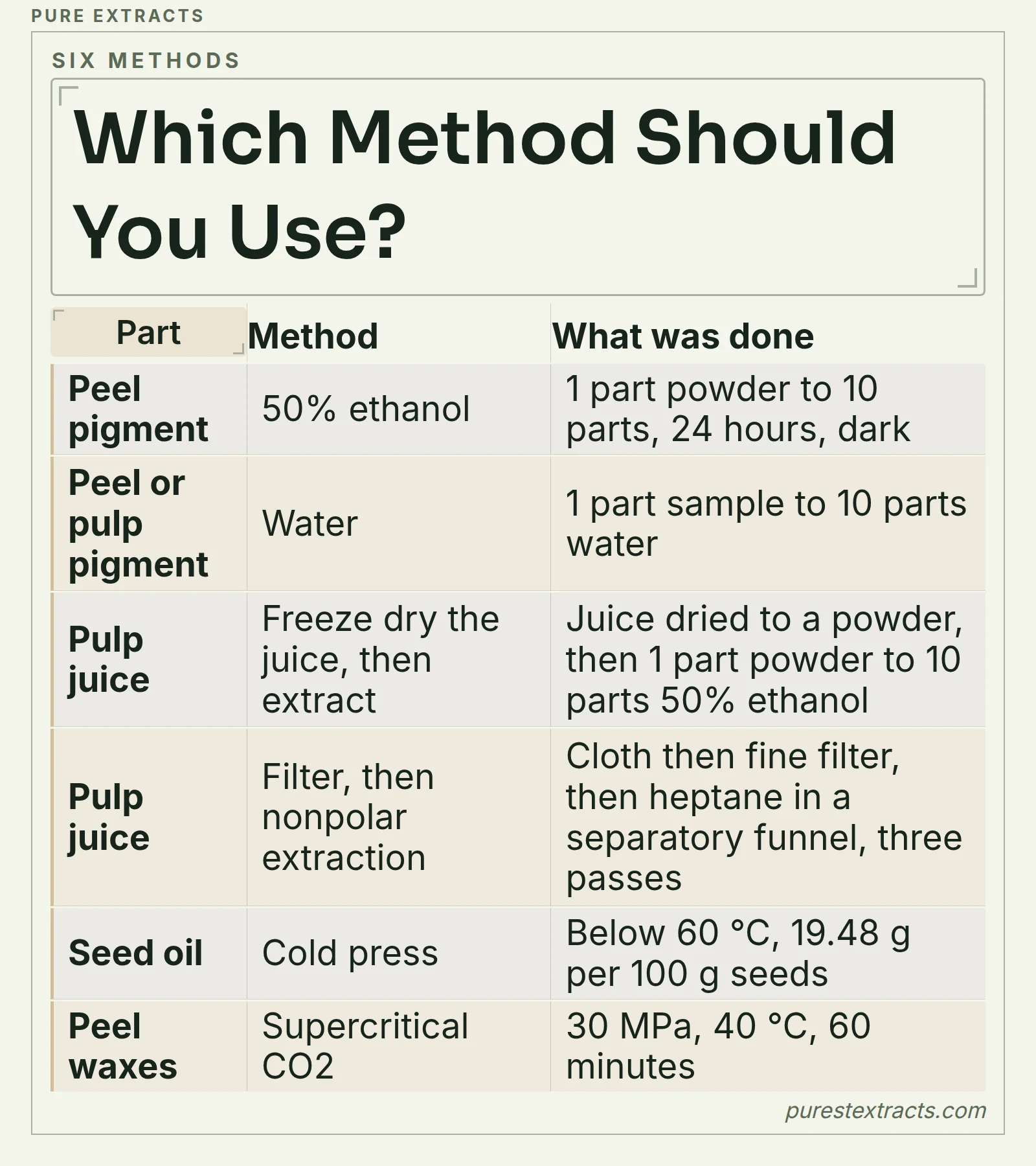
For a home kitchen, water and alcohol are the realistic choices, and the cold press is realistic only if you have a seed press and a lot of seeds. The industrial method is described here so you understand what a commercial extract may have been made with, not so you can copy it.
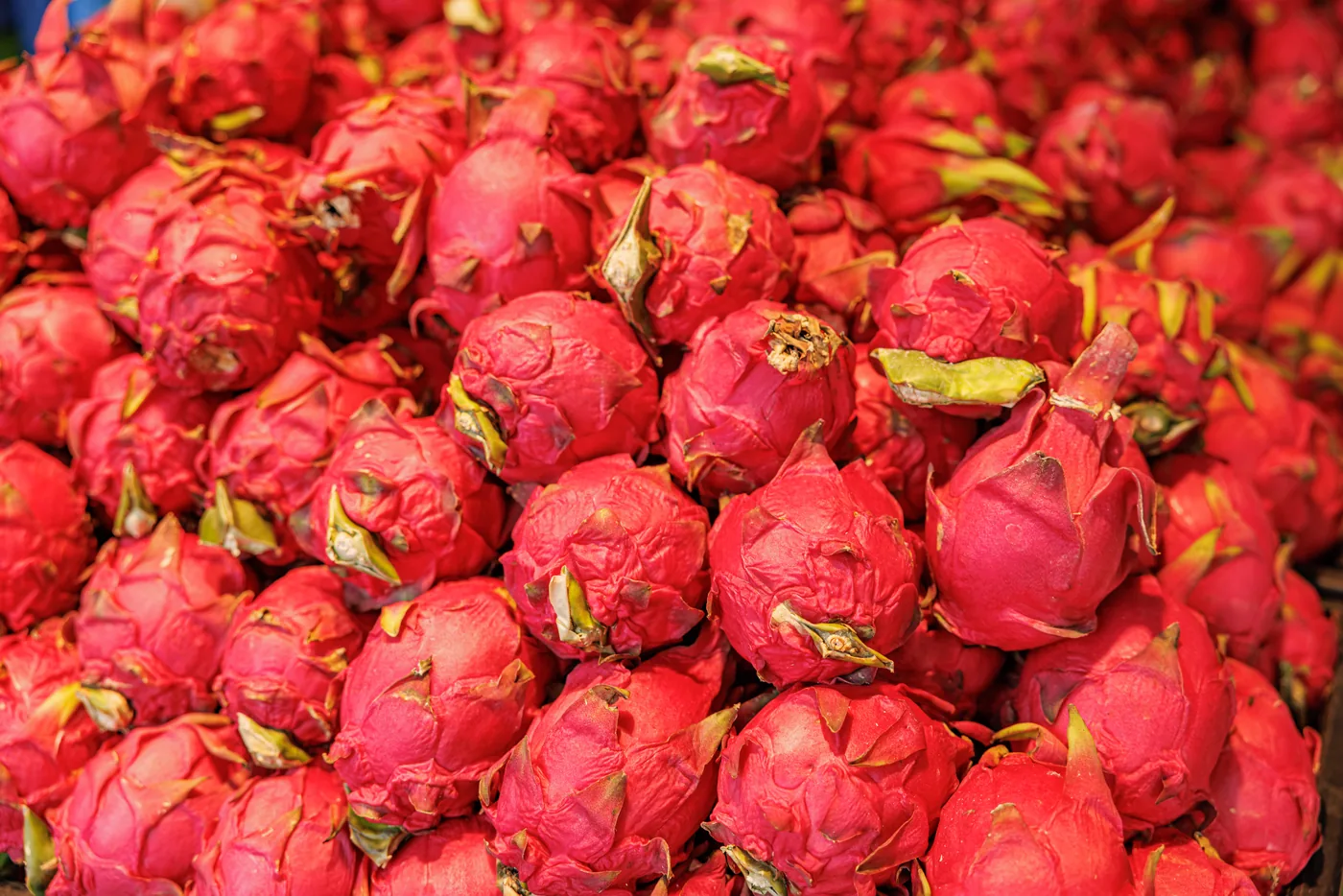

Every fruit you buy or harvest should be firm, clean and fully colored. Wash the skin before you cut it, since the peel is the part you will be extracting and you do not want soil or sprays in the jar.
Best Method For Each Compound
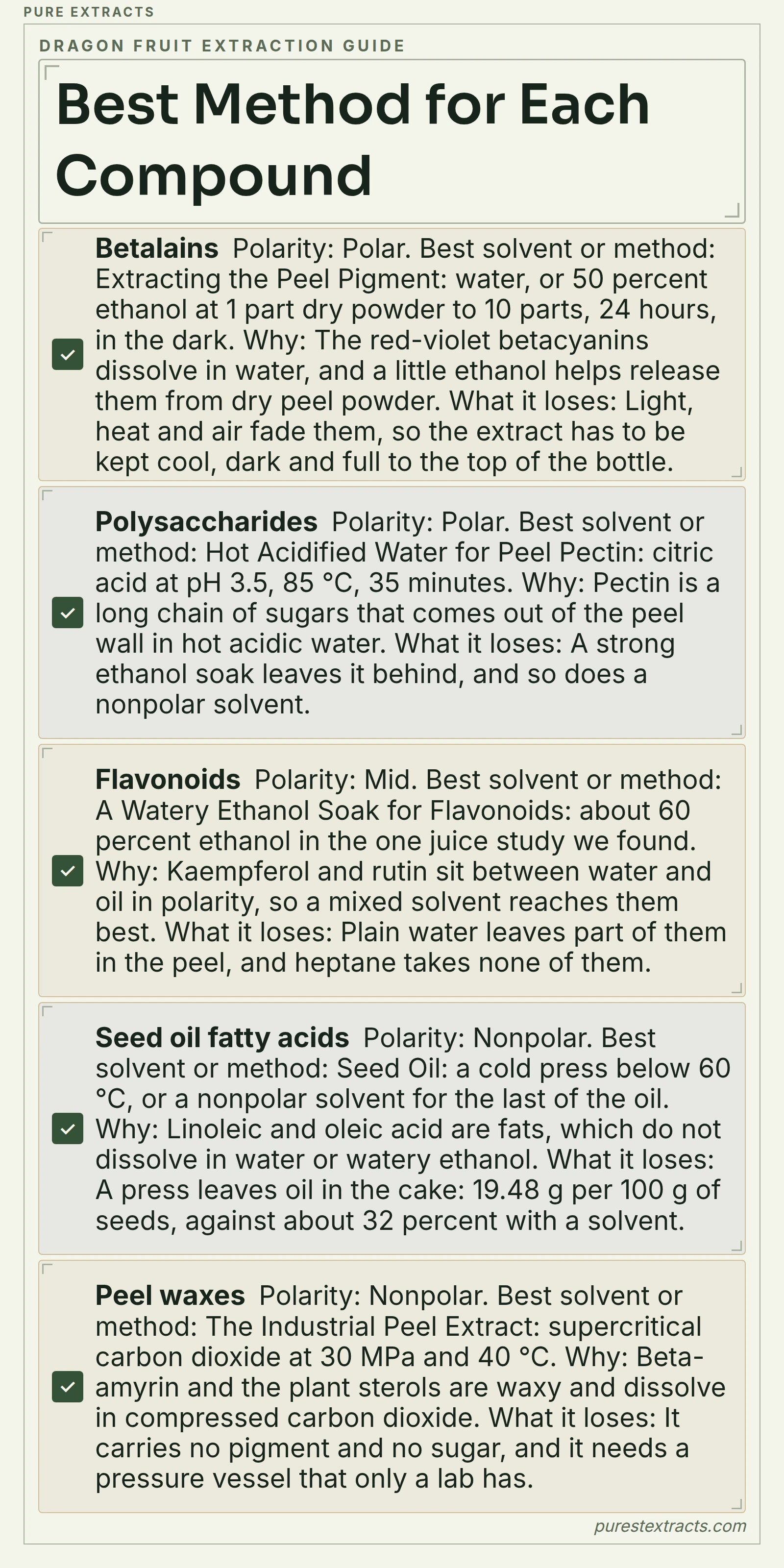
Dragon fruit is mostly water and sugar, so most of what people want from it is water-loving, and the method has to follow that. The pigments and the pectin sit in the polar group and lead the list, the flavonoids sit in the middle, and only the seed oil and the peel waxes are oily. A nonpolar solvent is the right tool for those two and the wrong tool for everything else.
| Compound | Polarity | Best solvent or method | Why | What it loses |
|---|---|---|---|---|
| Betalains | Polar | Extracting the Peel Pigment: water, or 50 percent ethanol at 1 part dry powder to 10 parts, 24 hours, in the dark | The red-violet betacyanins dissolve in water, and a little ethanol helps release them from dry peel powder | Light, heat and air fade them, so the extract has to be kept cool, dark and full to the top of the bottle |
| Polysaccharides | Polar | Hot Acidified Water for Peel Pectin: citric acid at pH 3.5, 85 °C, 35 minutes | Pectin is a long chain of sugars that comes out of the peel wall in hot acidic water | A strong ethanol soak leaves it behind, and so does a nonpolar solvent |
| Flavonoids | Mid | A Watery Ethanol Soak for Flavonoids: about 60 percent ethanol in the one juice study we found | Kaempferol and rutin sit between water and oil in polarity, so a mixed solvent reaches them best | Plain water leaves part of them in the peel, and heptane takes none of them |
| Seed oil fatty acids | Nonpolar | Seed Oil: a cold press below 60 °C, or a nonpolar solvent for the last of the oil | Linoleic and oleic acid are fats, which do not dissolve in water or watery ethanol | A press leaves oil in the cake: 19.48 g per 100 g of seeds, against about 32 percent with a solvent |
| Peel waxes | Nonpolar | The Industrial Peel Extract: supercritical carbon dioxide at 30 MPa and 40 °C | Beta-amyrin and the plant sterols are waxy and dissolve in compressed carbon dioxide | It carries no pigment and no sugar, and it needs a pressure vessel that only a lab has |
Each route is described in its own section, with the numbers from the study it came from. Match the method to the part and the compound you want, and write down the solvent, the ratio and the minutes for each batch so the next batch can be compared with it.
Preparing the Fruit
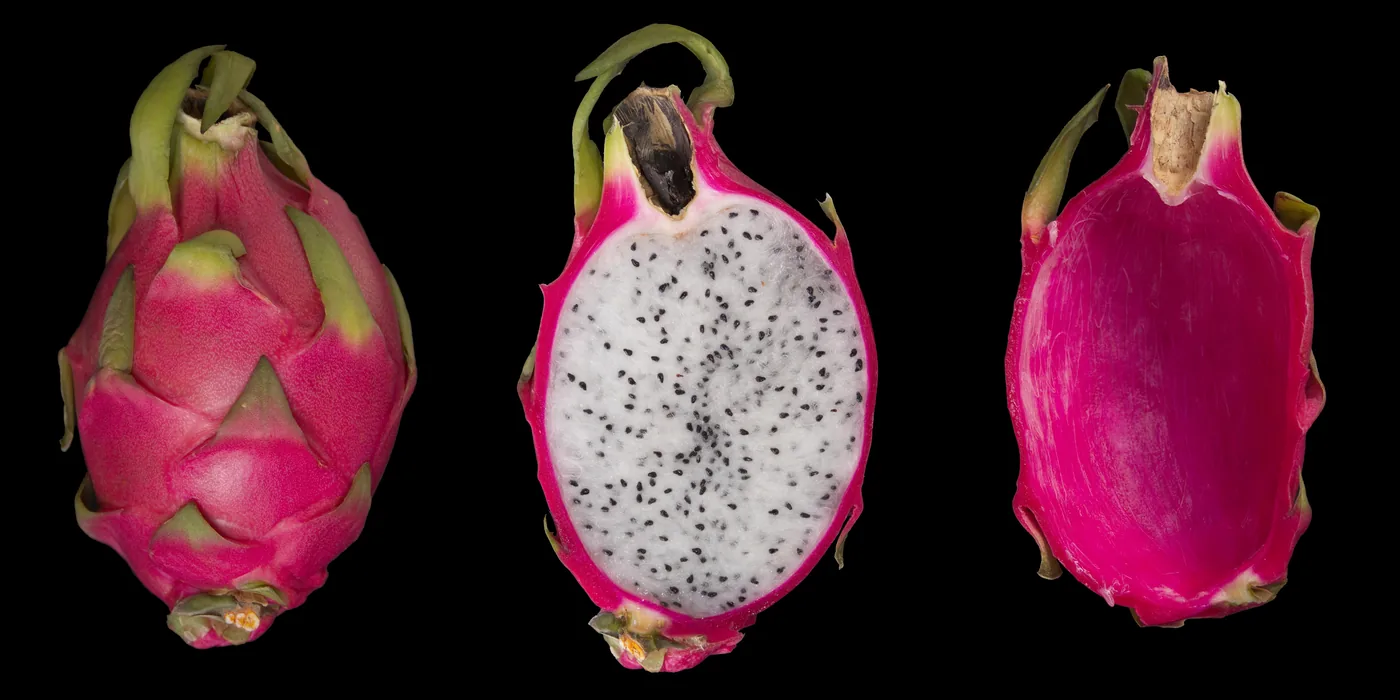
Preparation decides how much of the pigment you capture, and it is the step that most beginners rush. Separate the fruit into three piles before you do anything else: peel, pulp and seeds.

The peel
The peel is the pigment-rich part of white fruit, and a study of red-fleshed fruit gives a clear preparation. In that study the peel was cut into slices 1 by 5 cm, dried at 60 °C for 8 hours, and ground through a 60 mesh sieve, which gives a fine, even powder. A home oven set to its lowest setting, or a dehydrator at 60 °C, does the same job, and a thermometer tells you whether your oven is honest.
- Wash the fruit, cut it open and scoop out the pulp.
- Slice the peel into strips about 1 cm by 5 cm.
- Dry the strips at 60 °C for about 8 hours, until they snap.
- Grind them and pass the powder through a fine sieve.
- Weigh the powder and store it in a closed jar away from light.
Fine powder matters because the solvent can reach more of the peel. A coarse chunk leaves pigment locked in the middle, so regrind anything that does not pass through the sieve.
The pulp and the seeds
For pulp, the same study separated the flesh from peel and seeds with a slow juicer, a machine that presses rather than chops. A slow juicer lets you work through the fruit in one pass, and it leaves the peel and the seeds behind as separate piles.
The seeds can be rinsed in a strainer, dried at low heat and stored dry. You will need a lot of them, as the oil section below explains.
Making Juice From the Pulp
Juice is the simplest product and the one the fruit is built for. Run the pulp through a slow juicer, strain it, and drink it fresh or freeze it in small portions.

Fresh juice has a short life because the fruit is so wet. Freeze what you will not drink within a day or two, and label each container with the date. If you want a shelf-stable powder, the studies we found dried the juice with a carrier, a sugar-like material called maltodextrin that coats the pigment and protects it.
In that work, the maltodextrin was used alone or mixed 1 to 1 with gum arabic, at 1 part juice solids to 3 parts coating, and the mix was dried in a vacuum oven for 10 hours at 50 °C. The finished powders held 82.56 to 156.82 micrograms of betacyanin per gram from juice, against 52.51 to 75.12 micrograms per gram for a powder made from a peel extract. Those numbers come from red-fleshed fruit, so expect much lower values from white pulp.
Two Juice Routes
A juice is the starting point for two more methods, and the split between them is a question of which compounds you want to keep. Betacyanins, the red-violet pigments, dissolve in water, so a method that keeps the water phase keeps the pigment, and a method that pulls fat-soluble compounds out of the water leaves the pigment behind.
| Route | What it keeps | What it loses | Best for |
|---|---|---|---|
| A: juice, freeze dry, extract the powder | Water-soluble pigment, sugars, phenolic acids | Volatile aroma, and any fat-soluble compounds that were never in the juice | A whole-fruit, water-soluble extract |
| B: juice, filter, nonpolar extraction | Fat-soluble compounds in the solvent layer, and a cleaner juice in the water layer | The pigment and sugars stay in the water, so the solvent layer is colorless | Taking the fat-soluble fraction out of the pulp |
Pulp from white-fleshed fruit is pale and low in pigment, so either route gives a modest yield, and a scale and a notebook tell you more than any figure from a red-fleshed study.
Route A: Juice, Freeze Dry the Juice, Extract the Powder
Freeze drying removes water as ice vapor at low temperature, which is why it is the gentlest way to turn a juice into a powder. Heat is the main enemy of betacyanins, and this route never heats the juice.
- Press the pulp in a slow juicer and weigh the juice.
- Strain the juice through a fine cloth to remove the seeds.
- Pour it into shallow trays, about 1 cm deep, and freeze the trays solid at -20 °C or colder.
- Run the freeze dryer until the cake is dry and brittle.
- Grind the cake and seal it in a foil bag with a drying packet, away from light.
- Extract 10 g of powder in 100 mL of 50 percent ethanol in the dark, as for the peel, then strain and filter.
This route keeps the pigment and the other water-soluble compounds together, which is its strength, and it loses volatile aroma and anything fat-soluble that never dissolved in the juice. Seeds that slip through the strainer add oil to the cake, so strain well.
Route B: Juice, Filter Further, Extract With a Nonpolar Solvent
The second route treats the juice as a water phase. A nonpolar solvent does not mix with water, so when it is shaken with the juice the two separate into layers, and fat-soluble compounds move into the solvent. This is liquid-liquid extraction.
- Juice the pulp and strain it through a fine cloth.
- Filter again through a coffee filter and then a fine membrane or 5 micrometer cartridge, until the juice is clear. Particles make a stubborn cuff of foam between the layers.
- Chill the juice to 4 °C and measure its volume.
- Pour it into a separatory funnel and add heptane at 1 part to 2 parts of juice.
- Stopper, invert, and open the tap at once to vent. Shake gently for a minute and vent again.
- Let the layers settle, drain the water layer, and collect the solvent layer.
- Repeat twice on the water layer, combine the solvent fractions, dry them over anhydrous sodium sulfate, and evaporate the solvent under vacuum at 40 °C or lower.
What does this route keep? The fat-soluble fraction, in a small solvent layer, and it moves the pigment nowhere, because betacyanins prefer water. The washed water layer is still a juice, so keep it, cold and in the dark. Keep the pH between 3 and 6 for any pigment you save, since the ten-day tests in the color section below showed far more loss at pH 1.
| Solvent | Main hazard | How to handle it |
|---|---|---|
| Heptane | Highly flammable, closed-cup flash point near -4 °C, vapor heavier than air | Fume hood or open air, no flame or spark, grounded metal containers |
| Ethyl acetate | Flammable, irritates eyes and airways | Ventilated space, no open flame |
| Methanol | Toxic if swallowed or breathed | Never use it for anything that will be tasted |
Heptane vapor sinks and spreads along the floor, so a leak finds a pilot light across the room. Work outdoors or under a hood, and treat the solvent fraction as a laboratory material that is not for eating.
Which Route First?
Start with Route A if the pigment is what you want and you have a freeze dryer or a freezer and vacuum chamber, because it keeps the whole water-soluble fraction together and never heats the juice. Start with Route B if you want to learn what fat-soluble material the pulp holds, because it costs only glassware and a few passes with a solvent.
Many shops run both on the same batch of juice. They split it, freeze dry half, extract the other half with heptane, and weigh what each route returns. The two weights, written on a batch card, teach more about white-fleshed fruit than any figure from a red-fleshed study, and they take one afternoon to collect.
Extracting the Peel Pigment
This is the main event for anyone who wants a natural color or a pigment-rich extract. Two solvents have good support, water and ethanol, and a third pair were tested in the lab, acetone and methanol.
The 50 percent ethanol method
The peel study used 50 percent aqueous ethanol, which means equal strength of alcohol and water by volume. Researchers used 1 part dried peel powder to 10 parts solvent, let the mix stand for 24 hours in the dark, and then evaporated the solvent at 50 °C until the extract was about 10 percent moisture.
- Weigh 10 g of peel powder into a clean glass jar.
- Add 100 mL of 50 percent ethanol. If you are starting from 95 percent food-grade alcohol, mix about 10 parts of it with 9 parts of water.
- Close the jar, wrap it in foil or keep it in a dark cupboard, and let it stand for 24 hours.
- Strain through a fine cloth and then a coffee filter.
- Keep the liquid in a dark bottle in the refrigerator.
We found no tested ratio for a dragon fruit tincture, so the numbers above come from the study and not from a traditional recipe. The study evaporated the solvent in a lab machine, and a home cook cannot match that, so treat what you make as a liquid extract rather than a powder.
The water method
Water is the cheapest, safest solvent, and it dissolves betacyanins well. A study of red-fleshed peel and pulp used 5 g of sample in a total of 50 mL, centrifuged at 3,000 g for 10 minutes, so the ratio was 1 part sample to 10 parts liquid, the same as above. For a kitchen extract you can stir the mix, leave it for a few hours in the fridge, and filter it.
That study also tested 80 percent acetone and 80 percent methanol, two lab solvents. They are not for the kitchen, because methanol is toxic and acetone is flammable. They are listed here only to show what the numbers mean.
| Day-1 pigment, red-fleshed fruit | Peel | Pulp |
|---|---|---|
| Water, best pH tested | 36.05 mg/100 g at pH 1 | Not listed as a day-1 top result |
| Methanol | 35.08 mg/100 g at pH 6 | 43.41 mg/100 g at pH 6 |
| Acetone | 20.27 mg/100 g at pH 6 | 19.00 mg/100 g at pH 6 |
Water performed about as well as methanol for the peel, and acetone was the weakest solvent, so a safe solvent is not a worse choice. Pulp held more pigment than peel in that study, which agrees with the idea that red fruit is the better source.
Hot Acidified Water for Peel Pectin
The peel holds more than pigment. Pectin, a long chain of sugars that works as a gelling agent, is one of the polysaccharides in the peel wall, and it is a water route like the pigment, not an oil route. Pectin comes out of the peel in hot water that has been made mildly acidic.
A Vietnamese study of dragon fruit peel tested the settings and reported the best conditions it found.
- Acid: citric acid, adjusted to pH 3.5.
- Peel: dried and ground fine, with a particle size of 1 mm or less.
- Amount of liquid: 34.23 parts of liquid to 1 part of peel by weight.
- Heat and time: 85 °C for 35 minutes.
- Result: a pectin yield of 13.81 percent.
The abstract we could read does not say which species or flesh color the peel came from, so treat the yield as a starting point and weigh your own batch. Citric acid is the mildest choice, and it is sold as a food ingredient. Do not use a strong mineral acid in a home kitchen.
After the hot step, filter the liquid while it is warm. Pectin does not dissolve in strong ethanol, which is why ethanol is the usual way to bring it out of the filtered extract as a solid. Write down the pH, the temperature and the minutes, because a few degrees or a few minutes can change the yield.
A Watery Ethanol Soak for Flavonoids
A review of 57 studies found flavonoids to be the main class of phenolic compounds in both the pulp and the peel, with kaempferol and rutin the most prominent. Flavonoids are neither oily nor sugary, so they dissolve best in a solvent that is part water and part ethanol.
The best strength depends on the fruit. In a study of red pitaya juice, the flavonoid content of juice from Malaysia peaked at 60 percent ethanol, while the betacyanins in the same juice did best with no ethanol at all. That is the reason for a separate soak: the pigment route and the flavonoid route want different solvents, so one jar cannot be best for both.
- Dry the peel or the pulp at 60 °C and grind it to a powder.
- Weigh 10 g of powder into a jar and add 100 mL of 60 percent ethanol, which is 1 part powder to 10 parts liquid.
- Seal the jar, keep it in the dark and shake it now and then.
- Filter through a fine cloth and then a coffee filter, and label the bottle with the part, the strength and the date.
We found no published time for a flavonoid soak of dragon fruit, so the 24 hours used for the peel pigment is a sensible start, and a second batch at a different strength will tell you more than any figure here. The pigment from the same powder will come out too, and the extract will be red-tinged if the fruit was red.
Keeping the Color
Pigment is only useful if it survives storage, and it is fragile. The same study stored extracts for 10 days at room temperature, covered in foil and kept in the dark, at three acid levels.
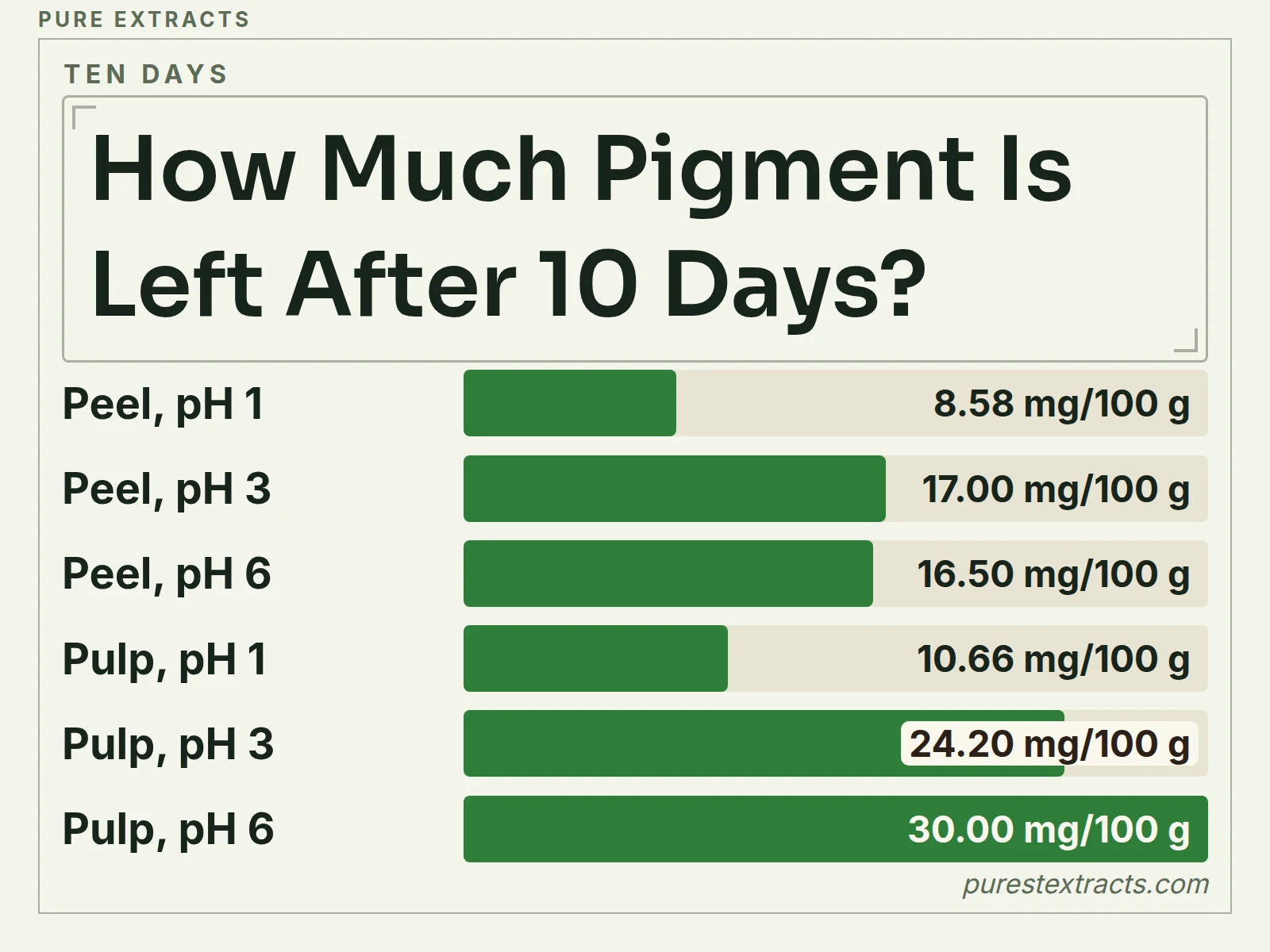
Notice what the bars say. Pigment at pH 1, which is very acidic, fell fastest, while pH 3 and pH 6 held much more. In the peel, day-1 pigment at pH 1 was the highest of the set, at 36.05 mg per 100 g, and by day 10 it had dropped to 8.58, which is a loss of about three quarters. Do not make the extract more acidic to get a stronger color, because you may be buying color that vanishes.
The authors also cite earlier work reporting an 80 to 90 percent color change after one week of storage. Their own results are gentler, but they show the same lesson: heat, light, air and strong acid all work against the pigment. Keep extracts cold, dark and sealed, and use them quickly.
Powders and storage tests
For a powder, a separate study stored the coated peel and juice powders for 30 days at 22 to 24 °C and 10 percent relative humidity in foil bags. Betacyanin changed by 9.71 to 12.5 percent in juice powder and by 2.91 to 27.64 percent in peel powder, with the best result for peel from a maltodextrin and gum arabic blend. A desiccator, which is a sealed box with a drying agent, kept the humidity low.
The study did not report a half-life, so we cannot tell you how long a powder keeps its color. Treat 30 days as the longest period with data, and test any batch you plan to keep.
Seed Oil
The seeds are small, black and numerous, and they contain a pale oil that has drawn attention for its fatty acids. A cold-pressed oil from red pitaya seeds was analyzed in a recent study, and its makeup looks like this.
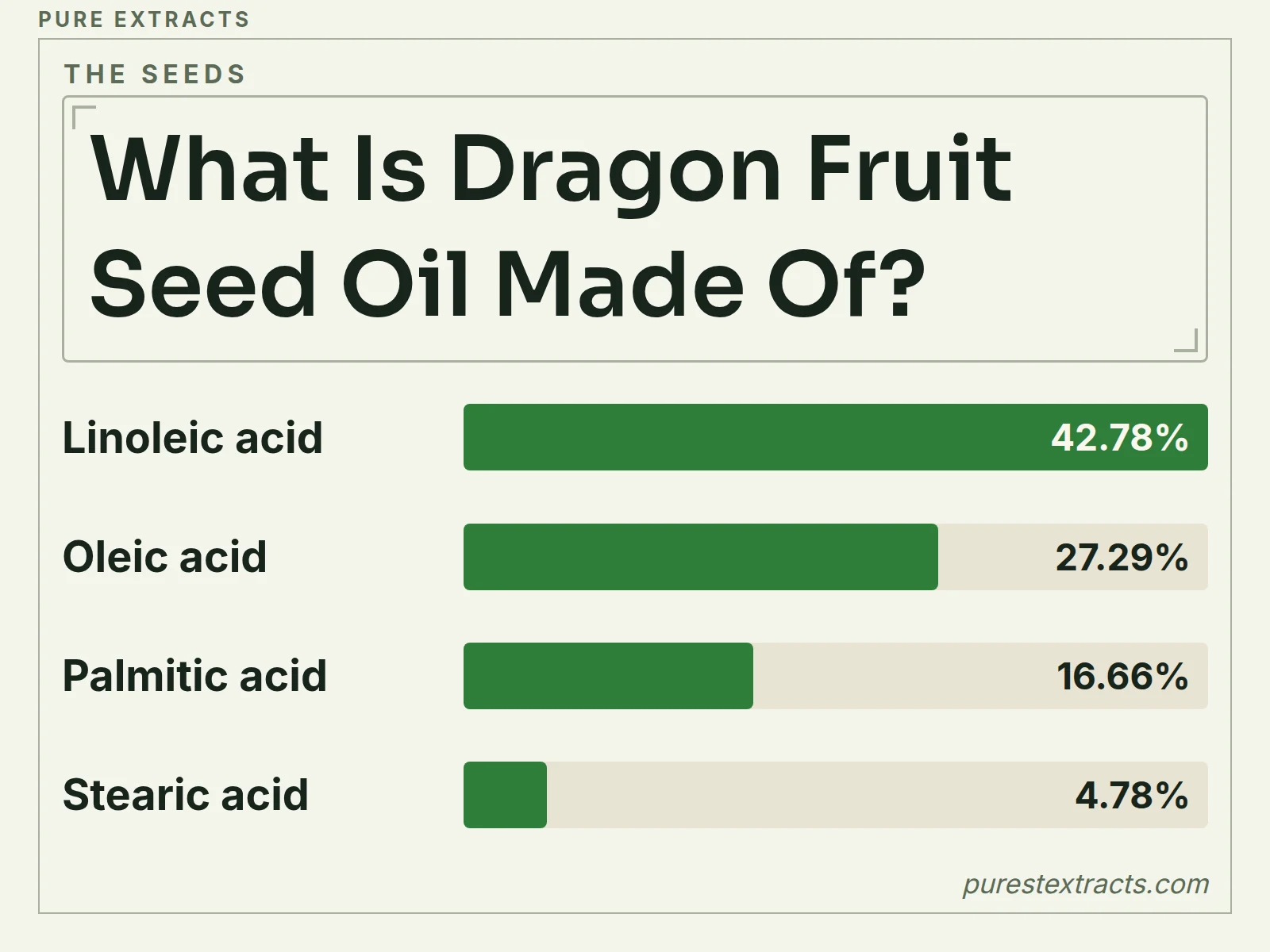
The oil is about three quarters unsaturated fat, with linoleic acid the largest share. Another source gives oleic acid at about 22 percent and linoleic at about 50 percent for the seed oils of this species and the red-fleshed one, so the exact split changes from sample to sample. The same paper warns that its own tables disagree in places, so use these numbers as ranges, not as fixed values.
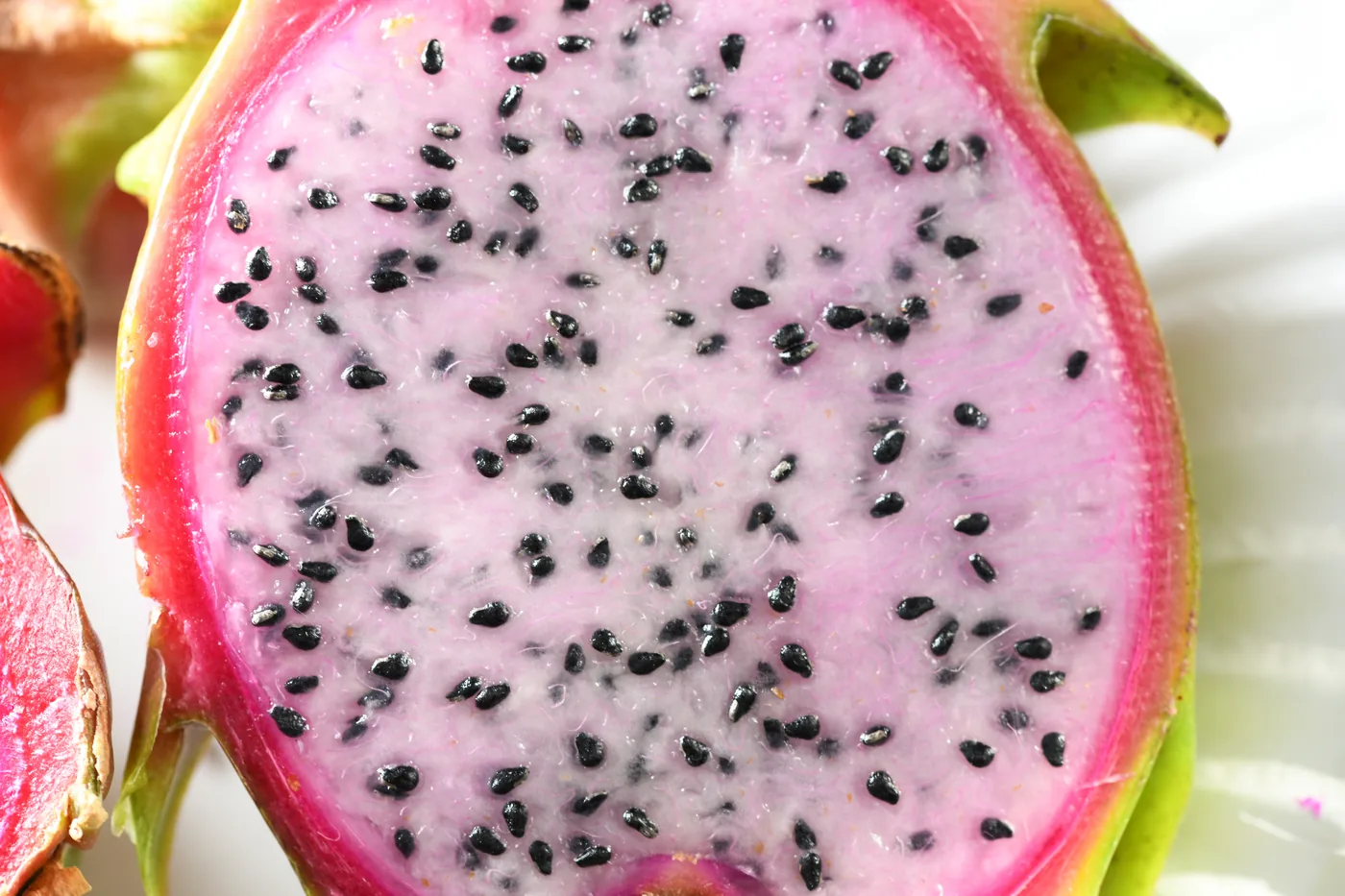

How is it made? The study cold pressed the seeds in a single-screw press below 60 °C and then spun the oil at 5,000 revolutions per minute for 10 minutes to clear it. It recovered 19.48 g of oil from every 100 g of seeds. Solvent extraction in the literature reaches about 32 percent, so a press leaves some oil in the cake.
That yield is the practical limit. At about 19.5 percent, you need roughly 5 kg of dry seeds for 1 kg of oil, and a single fruit has few seeds by weight, so a home press needs a very large harvest. Keep the oil in a dark, full bottle. We found no storage test for this oil, so we cannot give a shelf life.
The fatty acids in seed oil are nonpolar, so this is one of the two places in the fruit where a press or a nonpolar solvent is the right tool. For the pigment and the pectin, use water instead.
The Industrial Peel Extract
A commercial extract can look very different from your kitchen jar. One study extracted dried peel with supercritical carbon dioxide, a method that uses gas squeezed into a liquid-like state, at 30 MPa and 40 °C for 60 minutes, with a gas flow of 30 liters an hour, starting from about 250 g of dried peel.
| Peel | Yield | Largest compound |
|---|---|---|
| White-fleshed Selenicereus undatus | 1.25 percent | Beta-amyrin, 23.39 percent |
| Red-fleshed Hylocereus polyrhizus | 1.81 percent | Beta-amyrin, 15.87 percent |
The white-fleshed peel gave the smaller yield. The main compounds in the white-fleshed extract were beta-amyrin at 23.39 percent and gamma-sitosterol at 19.32 percent, two waxy plant compounds, and the result is a fatty extract, not a pigment. It needs a pressure vessel, so it belongs in a lab.
Equipment
Most of what you need is already in a kitchen, and the rest is inexpensive. Here is what each job asks for.
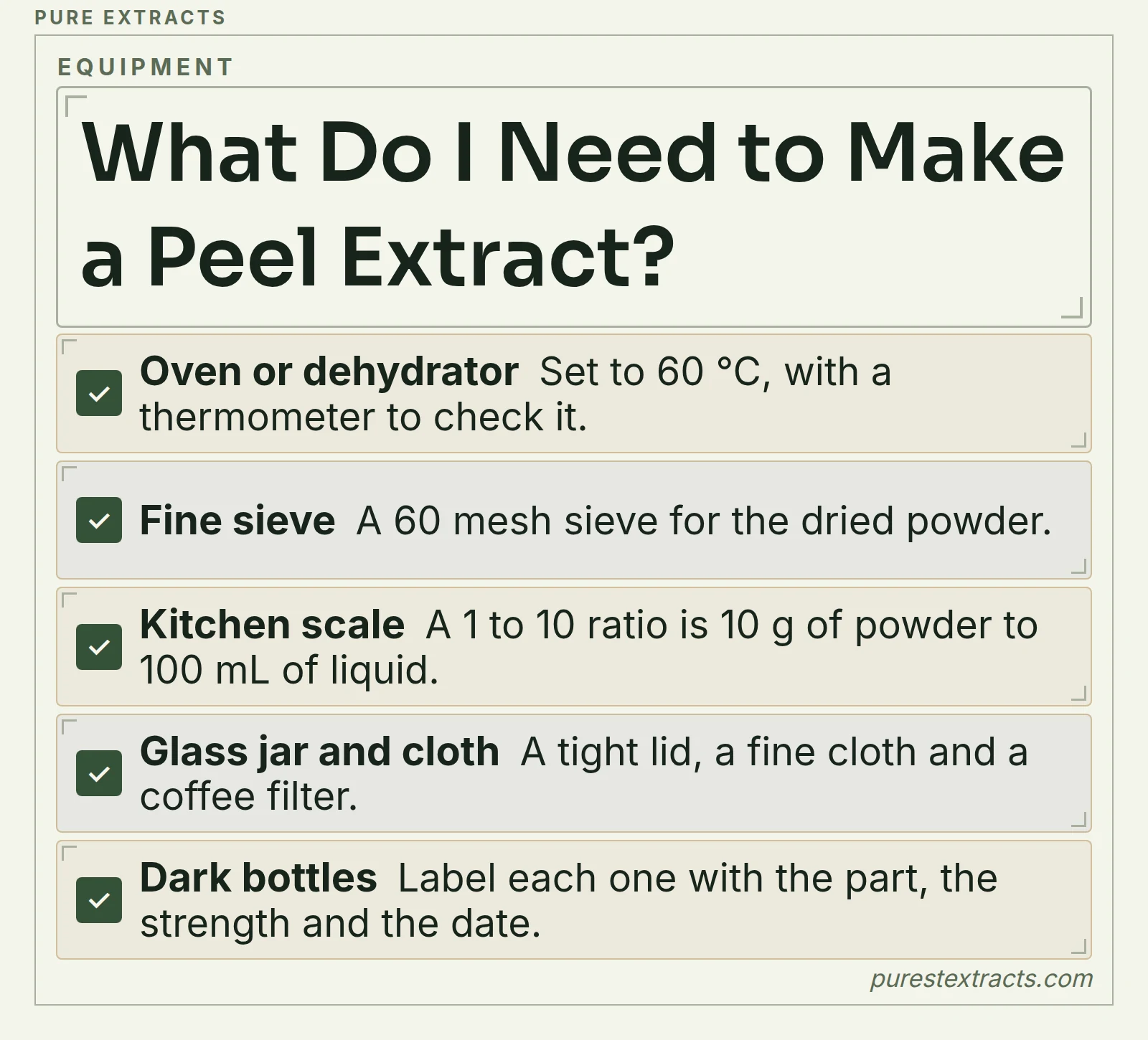
A thermometer is the cheapest tool on the list and the one that prevents the most mistakes, because an oven that runs hotter than its dial is an easy way to lose color before you even start.
How to Make a Glycerite: Glycerin Herbal Extracts
The alcohol-free extract: which herbs suit vegetable glycerin, how much water to add, how to make it and how long it keeps.
For a More In-Depth Read, Click HereWhat the Evidence Says
Many claims are made about this fruit, so it helps to separate what has been tested in people from what has only been seen in a dish. The review authors say the compounds in dragon fruit are linked to antioxidant, anti-inflammatory and antimicrobial properties, and they call for clinical trials. A review also concluded that pitayas are promising sources of pigment for the food industry.
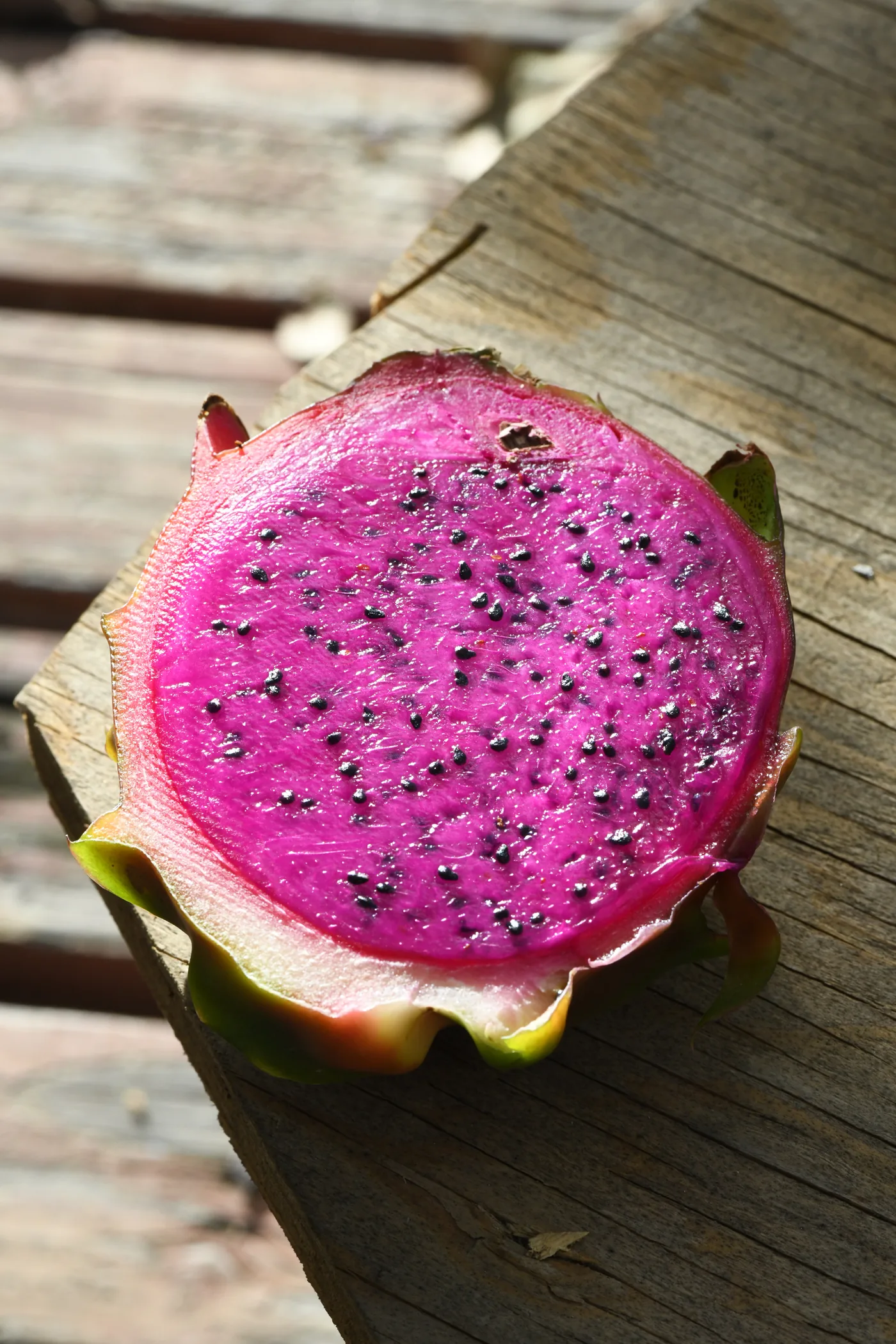

Only one human trial is cited here, and it used a powder, not an extract. It was a randomized, double-blind, placebo-controlled crossover study in 19 healthy young adults, of whom 18 finished. Each person took 24 g a day of whole dragon fruit powder, which carried 33 mg of betalains, or a matched placebo, for 14 days.
| Measure | Result against placebo |
|---|---|
| Blood vessel widening, at 4 hours | Up 1.3 percentage points |
| Blood vessel widening, after 14 days | Up 1.3 percentage points |
| Pulse-wave velocity, at 3 hours | Down 0.5 m/s |
| Augmentation index, after 14 days | Down 7.0 percent |
| Blood pressure | No difference at any time |
These are small numbers in a small group. The trial tested a betalain-rich powder, so it tells you nothing about a white-fleshed peel extract, and it found no change in blood pressure at all. Treat these findings as early, and do not read them as a treatment for any condition.
How to Filter and Clarify an Extract: Carbon, Bentonite and Silica
From coarse straining to fine filters, and how activated carbon, bentonite clay and silica clean up an extract.
For a More In-Depth Read, Click HereSafety
Safety comes in two parts for this fruit, the foods and the alcohol. Check this list before you make or take anything.
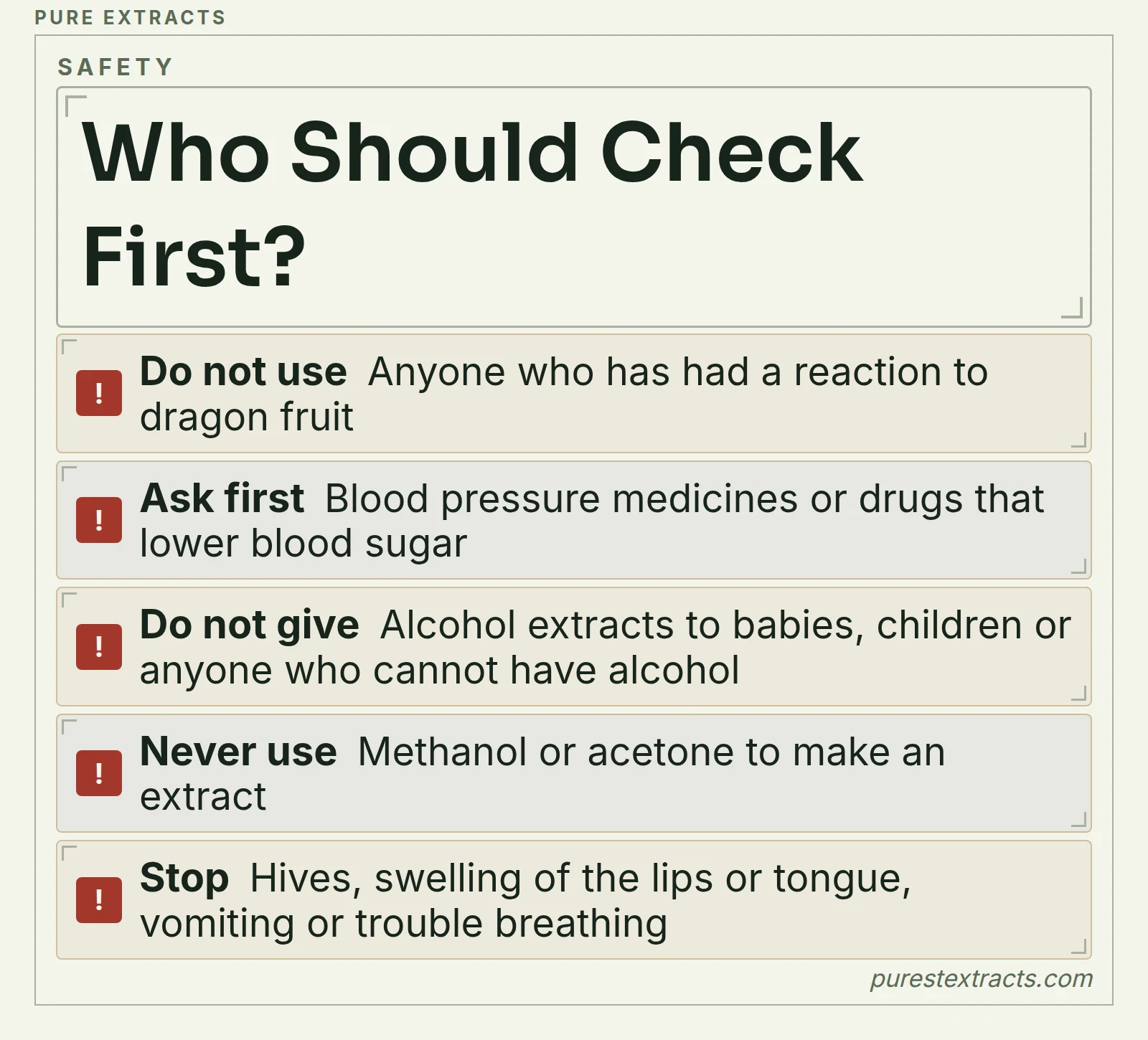
What to do
These steps keep both the cook and the people around you out of trouble.
- Try a small piece of fruit first if you have never eaten it, because allergic reactions have been reported.
- Ask your doctor before you take it regularly if you use blood pressure medicine or a drug that lowers blood sugar, since one extension source says the fruit may interact with these.
- Work with alcohol away from flames and hot burners, and keep the jar tightly closed.
- Label every jar and bottle with the part used, the alcohol strength and the date, and store them out of reach of children.
- Stop and get medical help if you notice hives, swelling of the lips or tongue, vomiting or trouble breathing.
A case report described a 26-year-old man with no history of allergies who had anaphylaxis, a severe allergic reaction, after eating dragon fruit. His skin tests were positive to the fruit and negative to the other foods and pollens tested. The authors conclude that the allergy can occur on its own and without cross-reactions, so a clean history with other fruit is not protection.
What not to do
Each of these has been a cause of ruined batches or real harm.
- Do not use methanol or acetone to make an extract, since both were lab solvents in the study and neither belongs in a kitchen.
- Keep the drying temperature at or under the 60 °C used in the study unless you test the result, because heat is hard on the pigment.
- Skip strong acid when you want more color, because pigment at pH 1 fell fastest.
- Never promise anyone that an extract treats or prevents a disease, because no trial tested your extract.
- Keep extracts away from babies, young children or anyone who cannot have alcohol.
One more point is practical rather than medical. The pigments stain skin, cloth and countertops, so work on a surface you can wash.
Troubleshooting
Most problems with a homemade extract have a simple cause, and the usual ones are in this list.
| What you see | The usual cause | What to do |
|---|---|---|
| The extract is pale | White pulp has little or no pigment | Use the peel, or switch to red-fleshed fruit |
| Color fades within days | Light, heat, air or a very low pH | Store it cold, dark and sealed, near pH 3 to 6 |
| Powder clumps | Moisture got in | Dry it again and store it in a sealed bag with low humidity |
| Little oil from the press | Too few seeds, or seeds that were wet | Collect more seeds, dry them first and expect about 19 percent |
| Mold in a juice or water extract | Fresh fruit holds 84 percent water | Freeze it, or discard the batch and start again |
If a problem is not on the list, the safest response is the plain one. Throw the batch out and begin again with clean equipment and fresh, firm fruit.

Common Questions
These are the questions people ask most often about extracts from this fruit.

Each answer below is short, and the sections above give the detail behind it.
Can you get the red pigment from white-fleshed fruit?
Not from the pulp, which is reported to hold no betacyanins. The peel of white fruit has some, but it has less than red-fleshed peel.
What is the best solvent?
Water and 50 percent ethanol both have support. In the study that compared them, water extracted peel pigment about as well as methanol, and acetone was weakest.
How long does the color last?
At room temperature in the dark, extracts lost much of their pigment within 10 days, depending on the acid level. Powders were tested for 30 days only, so there is no longer figure.
Can you make a tincture?
The study used 50 percent ethanol at 1 part peel powder to 10 parts liquid for 24 hours. There is no traditional ratio for dragon fruit in the sources we found, so use that one and label it as an experiment.
How much oil do you get from the seeds?
A cold press recovered 19.48 g of oil per 100 g of seeds. That means roughly 5 kg of seeds for 1 kg of oil.
Is it safe for everyone?
No. Allergy has been reported, and the fruit may interact with blood pressure and blood sugar medicines, so ask your doctor if you take either.
Does it lower blood pressure?
The one human trial we found, which used a powder, saw no change in blood pressure. It did see small changes in how well vessels widen.
Growing the Plant Yourself
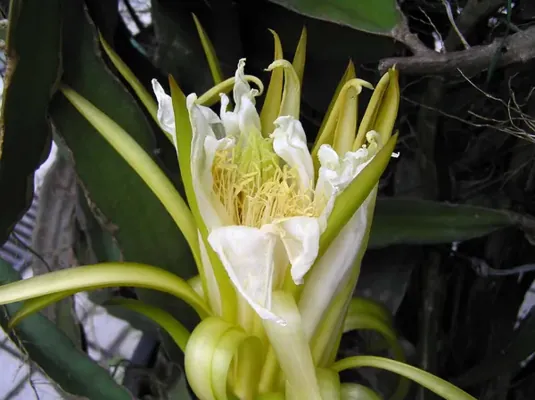
If you want your own supply of fruit, a single cutting can start a plant that produces within 6 to 9 months, and our partner website has the full growing guide.

Fruit from your own plant also lets you choose the part you extract and the day you harvest it.
Our partner website, Shearer Farms
Dragon Fruit (Selenicereus undatus) Guide: Starting Plants, Support, Pollination and Harvest
Grow dragon fruit (Selenicereus undatus): climate, soil pH, cuttings, trellis, watering, hand pollination, pruning.
References
- Optimizing technological parameters for pectin extraction from dragon fruit peels, Tran Thi Dinh, Vietnam Journal of Agricultural Sciences (2016): citric acid, pH 3.5, 85 °C, 35 minutes, 13.81 percent.
- Variability in nutritional composition and phytochemical properties of red pitaya (Hylocereus polyrhizus) from Malaysia and Australia, Nurul and Asmah, International Food Research Journal (2014): ethanol strength for phenolics, flavonoids and betacyanins.
- Wikipedia, Pitaya: species, betacyanins, nutrition per 100 g, seed oil fatty acids.
- Enhancing betacyanin stability: comparison of dragon fruit pulp and peel powders through encapsulation technology during storage, PMC.
- Stability of betacyanin pigment in peel and pulp of red flesh dragon fruit, Oriental Journal of Chemistry.
- The reported color formation mechanism in pitaya fruit is inconsistent, PMC: white pulp of H. undatus and betalains.
- Chemical composition of supercritical carbon dioxide extracts of pitaya peel, PMC.
- Analysis of lipids in pitaya seed oil by UPLC-TOF-MS/MS, PMC.
- The profile of phenolic compounds identified in pitaya fruits, health effects and food applications, Plants (2024).
- Betalain-rich dragon fruit (pitaya) consumption improves vascular function in men and women, American Journal of Clinical Nutrition (2022).
- Pitaya allergy: a case report of anaphylaxis in a patient without cross-reactive allergens, Allergy, Asthma and Clinical Immunology (2025).
- Nutritional value and therapeutic benefits of dragon fruit: a comprehensive review, Molecules (2024).
- North Carolina State Extension, Plant Toolbox: Selenicereus undatus, allergy and interaction notes.
- n-Heptane safety data sheet: flash point and flammable range.
Common questions
How do I choose a method?
Which method suits which part? The studies we found gave details for peel and pulp pigment, for seed oil, and for an industrial peel extraction, and juicing adds two more routes. Each differs in solvent, time and equipment. The choice starts with the compounds, not the equipment. Most of what this fruit holds is water-loving: the betalains in the peel and the pulp, and the pectin in the peel wall.
What is happening chemically in dragon fruit extraction?
Dragon fruit is mostly water and sugar, so most of what people want from it is water-loving, and the method has to follow that. The pigments and the pectin sit in the polar group and lead the list, the flavonoids sit in the middle, and only the seed oil and the peel waxes are oily. A nonpolar solvent is the right tool for those two and the wrong tool for everything else.
How do I prepare the fruit?
Preparation decides how much of the pigment you capture, and it is the step that most beginners rush. Separate the fruit into three piles before you do anything else: peel, pulp and seeds. The peel is the pigment-rich part of white fruit, and a study of red-fleshed fruit gives a clear preparation. In that study the peel was cut into slices 1 by 5 cm, dried at 60 °C for 8 hours, and ground through a 60 mesh sieve, which gives a fine, even powder. A home oven set to its lowest setting, or a dehydrator at 60 °C, does the same job, and a thermometer tells you whether your oven is honest.
How do I make juice from the pulp?
Juice is the simplest product and the one the fruit is built for. Run the pulp through a slow juicer, strain it, and drink it fresh or freeze it in small portions. Fresh juice has a short life because the fruit is so wet. Freeze what you will not drink within a day or two, and label each container with the date. If you want a shelf-stable powder, the studies we found dried the juice with a carrier, a sugar-like material called maltodextrin that coats the pigment and protects it.
What are two juice routes?
A juice is the starting point for two more methods, and the split between them is a question of which compounds you want to keep. Betacyanins, the red-violet pigments, dissolve in water, so a method that keeps the water phase keeps the pigment, and a method that pulls fat-soluble compounds out of the water leaves the pigment behind. A: juice, freeze dry, extract the powder (Water-soluble pigment, sugars, phenolic acids, Volatile aroma, and any fat-soluble compounds that were never in the juice): A whole-fruit, water-soluble extract.
What is extracting the peel pigment?
This is the main event for anyone who wants a natural color or a pigment-rich extract. Two solvents have good support, water and ethanol, and a third pair were tested in the lab, acetone and methanol. The 50 percent ethanol method. The peel study used 50 percent aqueous ethanol, which means equal strength of alcohol and water by volume. Researchers used 1 part dried peel powder to 10 parts solvent, let the mix stand for 24 hours in the dark, and then evaporated the solvent at 50 °C until the extract was about 10 percent moisture.
What is hot acidified water for peel pectin?
The peel holds more than pigment. Pectin, a long chain of sugars that works as a gelling agent, is one of the polysaccharides in the peel wall, and it is a water route like the pigment, not an oil route. Pectin comes out of the peel in hot water that has been made mildly acidic. A Vietnamese study of dragon fruit peel tested the settings and reported the best conditions it found. Acid: citric acid, adjusted to pH 3.5.
What are a watery ethanol soak for flavonoids?
A review of 57 studies found flavonoids to be the main class of phenolic compounds in both the pulp and the peel, with kaempferol and rutin the most prominent. Flavonoids are neither oily nor sugary, so they dissolve best in a solvent that is part water and part ethanol. The best strength depends on the fruit. In a study of red pitaya juice, the flavonoid content of juice from Malaysia peaked at 60 percent ethanol, while the betacyanins in the same juice did best with no ethanol at all.
What is keeping the color?
Pigment is only useful if it survives storage, and it is fragile. The same study stored extracts for 10 days at room temperature, covered in foil and kept in the dark, at three acid levels. Notice what the bars say. Pigment at pH 1, which is very acidic, fell fastest, while pH 3 and pH 6 held much more. In the peel, day-1 pigment at pH 1 was the highest of the set, at 36.05 mg per 100 g, and by day 10 it had dropped to 8.58, which is a loss of about three quarters.
What is seed oil?
The seeds are small, black and numerous, and they contain a pale oil that has drawn attention for its fatty acids. A cold-pressed oil from red pitaya seeds was analyzed in a recent study, and its makeup looks like this. The oil is about three quarters unsaturated fat, with linoleic acid the largest share. Another source gives oleic acid at about 22 percent and linoleic at about 50 percent for the seed oils of this species and the red-fleshed one, so the exact split changes from sample to sample. The same paper warns that its own tables disagree in places, so use these numbers as ranges, not as fixed values.
What is the industrial peel extract?
A commercial extract can look very different from your kitchen jar. One study extracted dried peel with supercritical carbon dioxide, a method that uses gas squeezed into a liquid-like state, at 30 MPa and 40 °C for 60 minutes, with a gas flow of 30 liters an hour, starting from about 250 g of dried peel. The white-fleshed peel gave the smaller yield. The main compounds in the white-fleshed extract were beta-amyrin at 23.39 percent and gamma-sitosterol at 19.32 percent, two waxy plant compounds, and the result is a fatty extract, not a pigment. It needs a pressure vessel, so it belongs in a lab.
What equipment does dragon fruit extraction need?
Most of what you need is already in a kitchen, and the rest is inexpensive. Here is what each job asks for. A thermometer is the cheapest tool on the list and the one that prevents the most mistakes, because an oven that runs hotter than its dial is an easy way to lose color before you even start.
Is dragon fruit extraction safe?
Safety comes in two parts for this fruit, the foods and the alcohol. Check this list before you make or take anything. These steps keep both the cook and the people around you out of trouble. Try a small piece of fruit first if you have never eaten it, because allergic reactions have been reported. Ask your doctor before you take it regularly if you use blood pressure medicine or a drug that lowers blood sugar, since one extension source says the fruit may interact with these.
What usually goes wrong with dragon fruit extraction?
Most problems with a homemade extract have a simple cause, and the usual ones are in this list. The extract is pale (White pulp has little or no pigment): Use the peel, or switch to red-fleshed fruit. Color fades within days (Light, heat, air or a very low pH): Store it cold, dark and sealed, near pH 3 to 6. Powder clumps (Moisture got in): Dry it again and store it in a sealed bag with low humidity. Little oil from the press (Too few seeds, or seeds that were wet): Collect more seeds, dry them first and expect about 19 percent.
How do I grow the plant yourself?
If you want your own supply of fruit, a single cutting can start a plant that produces within 6 to 9 months, and our partner website has the full growing guide. Fruit from your own plant also lets you choose the part you extract and the day you harvest it. Our partner website, Pure Extracts. Dragon Fruit (Selenicereus undatus) Guide: Starting Plants, Support, Pollination and Harvest . Grow dragon fruit (Selenicereus undatus): climate, soil pH, cuttings, trellis, watering, hand pollination, pruning.
Browse by topic
More guides to explore
 ExtractionCold Press Extraction
 ExtractionEnzymatic Extraction
 ExtractionEthanol Extraction
 ExtractionMicrowave-Assisted Extraction
 ExtractionNatural Dye Extraction and Use
 ExtractionPressurized Hot Water Extraction
 ExtractionSteam Distillation