Plants
How to Make a Feverfew Extract: Methods, Solvents and Shelf Life
Which parts of feverfew to use, which method pulls out its compounds, the solvent and ratio, safety and how long the extract keeps.

On this page
What are you extracting from feverfew?
Feverfew ( Tanacetum parthenium ) yields a complex chemical profile, making solvent choice critical. The plant is rich in sesquiterpene lactones, with parthenolide being the principal marker; dried leaves can contain up to 1% of this compound. Other phytochemicals include camphor, luteolin and apigenin. Because parthenolide content varies substantially, by more than 40-fold, standardization is challenging despite labeling claims. It’s important to note that feverfew leaf lacking parthenolide has not been clinically tested for migraine prophylaxis.
Extraction targets these compounds for anti-inflammatory effects, primarily through NF-κB inhibition. Parthenolide directly inhibits IKKβ, a key kinase in cytokine signaling. Additional mechanisms include prostaglandin synthesis inhibition and antiplatelet activity.
The best solvent depends on the desired extract. For maximum parthenolide capture, an ethanol tincture using 60-70% ethanol and 30-40% distilled water is appropriate, as this ratio suits alkaloids and glycosides. A higher proof, like 90-95% ethanol with 5-10% water, could be used for volatile oils present in the plant but requires extra solvent safety precautions.
Lower percentages, around 40-50% ethanol and 50-60% water, are suitable for flavonoids and phenolics. Glycerin extraction is possible using a 60% glycerin / 40% water ratio, though potency will be lower and shelf life limited to one or two years. Water extraction alone targets polar molecules but may not efficiently extract the full range of feverfew’s constituents. Careful consideration must be given to preserving heat-sensitive compounds during any process. Following extraction, filtering and clarifying is essential for a clean final product, followed by proper storing extracts.
How to Choose an Extraction Method for Any Herb
Match the method to the plant: what polarity and heat sensitivity mean, and which solvent pulls out which compounds.
For a More In-Depth Read, Click HereWhich extraction method suits feverfew, and why?
Feverfew’s chemical profile dictates the best approach to extraction. The plant contains sesquiterpene lactones - notably parthenolide - flavonoids, and other compounds. These vary in polarity, but the primary target, parthenolide, is present in concentrations as high as 1% in dried leaves, demanding a solvent capable of efficient recovery. [ethanol tincture] is the most suitable method.
The table shows that a 60-70% ethanol solution with 30-40% water suits alkaloids and glycosides; feverfew contains both. This ratio balances extraction efficiency with preserving delicate compounds. Lower percentages, like those used for tannins or mucilage, would leave parthenolide behind. Higher percentages (90-95%) are better for resins but less effective on the broader range of feverfew’s constituents.
Food-grade ethanol is essential; denatured alcohol is unacceptable due to toxicity. Starting with a high-proof spirit like Everclear and diluting with distilled water allows precise control over the final percentage. Vodka (40% ethanol) may work for leaves and flowers, but lacks adjustability and isn’t ideal for roots or resins if present in significant amounts.
Glycerin [glycerin extraction] is unsuitable as a direct replacement; it extracts fewer compounds and yields a less potent product with a shorter shelf life of one to two years. While apple cider vinegar [water extraction and decoction] might capture minerals, it won’t effectively extract the target sesquiterpenes or flavonoids.
Proper preparation includes using thoroughly [drying herbs] before extraction. Following extraction, techniques like [filtering and clarifying extracts] are crucial for a clean final product. Finally, correct [storing extracts] in airtight containers away from light will maintain potency for five years or more.
What solvent and ratio should you use for feverfew?
Feverfew’s active compounds include sesquiterpene lactones like parthenolide and flavonoids. To extract these effectively, an ethanol tincture is the preferred method. The plant is chemically complex, requiring a solvent that can capture a broad range of metabolites.
The table shows several ethanol percentages suited to different herb types; feverfew falls into the category best served by a 40-50% ethanol solution with 50-60% water. This ratio targets flavonoids and phenolics, present in feverfew alongside its key sesquiterpenes. A 60-70% ethanol/30-40% water mix is also suitable for alkaloids and glycosides, further broadening the extraction profile.
Using food-grade ethanol is essential; avoid denatured alcohol due to toxic additives. Begin with a high-proof ethanol like Everclear (95% ethanol) or organic grape alcohol and dilute it with distilled water to achieve the target percentage. Vodka (40% ethanol) could be used for simpler extractions of leaves and flowers, but lacks adjustability.
Parthenolide content in dried feverfew leaves can reach as high as 1%, so a thorough extraction is important. Standardization is difficult, however, with commercial supplements varying more than 40-fold despite labeling claims. This highlights the importance of careful preparation and consistent ratios when making your own extract.
Other methods like glycerin extraction or oil infusion are less effective at capturing the full spectrum of feverfew’s constituents, especially its more complex compounds. Water alone is insufficient for many of these molecules. Proper drying herbs before extraction is also crucial for shelf life and potency.
How to Make a Glycerite: Glycerin Herbal Extracts
The alcohol-free extract: which herbs suit vegetable glycerin, how much water to add, how to make it and how long it keeps.
For a More In-Depth Read, Click HereHow do you make a feverfew extract step by step?
Feverfew extracts require careful consideration of the plant’s chemistry and desired outcome. The plant is chemically complex, containing sesquiterpene lactones like parthenolide as key constituents. Because commercially available feverfew supplements vary substantially in parthenolide content, by more than 40-fold, accurate extraction is important. [ethanol tincture] is a common method for feverfew, offering good extraction of the plant’s diverse compounds.
Begin with thoroughly [drying herbs]. Use food-grade ethanol only; denatured alcohol is unsafe. A 60-70% ethanol solution (30-40% distilled water) is suitable as feverfew contains alkaloids and glycosides. This ratio balances potency and broad-spectrum extraction. Start with dried feverfew leaf material. The monograph does not specify a plant to solvent ratio, but standard tincture ratios are a good starting point.
Combine the herb and ethanol in a clean glass jar. Ensure the plant matter is fully submerged. Seal tightly and store in a cool, dark place for several weeks, shaking daily. This allows sufficient time for compounds to dissolve into the liquid. After this period, [filtering and clarifying extracts] is necessary to remove solid plant material. Use cheesecloth or a fine-mesh strainer followed by coffee filters if needed.
After filtering, consider [evaporating solvent] to concentrate the extract if desired. This must be done carefully with appropriate ventilation and heat control. Proper storage in airtight amber glass bottles away from light and heat is essential for maintaining potency; follow guidelines at [storing extracts]. Remember that parthenolide content can vary, and this method does not guarantee a specific concentration. Other methods like [glycerin extraction] are possible but will yield a less potent extract.
How to Filter and Clarify an Extract: Carbon, Bentonite and Silica
From coarse straining to fine filters, and how activated carbon, bentonite clay and silica clean up an extract.
For a More In-Depth Read, Click HereWho should be careful with feverfew?
Feverfew presents cautions for several groups. Anyone on blood-thinning medication should exercise care, as feverfew exhibits [STUDY] antiplatelet activity. This means it may increase the risk of bleeding. Individuals scheduled for surgery must discontinue use at least one to two weeks prior to the procedure, again due to its effect on platelet function.
Pregnancy and breastfeeding are absolute contraindications. Feverfew has a historical association with inducing menstruation and affecting labor during childbirth [TRADITIONAL], making it unsafe during these periods.
Allergies within the Asteraceae/Compositae family - ragweed, marigolds, daisies, chrysanthemums - indicate potential sensitivity to feverfew. Cross-reactivity is common. Start with a very small dose if you have known allergies and monitor for any reaction.
Gastrointestinal upset is possible, particularly with higher doses. Some individuals experience mouth ulcers or digestive discomfort.
Standardization of commercially available feverfew supplements is problematic; parthenolide content can vary by more than 40-fold despite labeling claims [ESTABLISHED]. Parthenolide, a key sesquiterpene lactone present in concentrations up to 1% in dried leaves [ESTABLISHED], is believed to be central to its effects. However, feverfew leaf lacking parthenolide has not been clinically tested for migraine prophylaxis [ESTABLISHED].
When preparing a feverfew extract, consider the target compounds and choosing a method. A 60-70% ethanol solution is suitable for alkaloids and glycosides, while a 40-50% solution works well for flavonoids and general use. Avoid using food-grade ethanol only; denatured alcohol is toxic solvent safety. Glycerin extraction [/articles/glycerin-extraction] is an alternative but yields lower potency and shorter shelf life. Proper drying herbs before extraction ensures optimal results, and careful filtering and clarifying removes particulate matter.
Before any solvent work: use glass or stainless steel rated for the solvent, work outdoors or beside a fan pulling the vapor away from you, heat ethanol only on an electric or induction hot plate (never an open flame or a gas burner), and do not breathe solvent vapor. This guide is education, not medical advice: check with a doctor before using any herbal extract alongside medication, during pregnancy or for a child.
How do you store a feverfew extract, and how long does it keep?
Feverfew extracts require careful storage to maintain potency. The ideal conditions depend on the solvent used during creation. [storing extracts] covers general principles, but feverfew has specifics due to its chemical profile.
Alcohol tinctures, made with ethanol percentages ranging from 25% to 95%, are the most stable. Use food-grade ethanol only; denatured alcohol is unsuitable. A properly prepared and stored ethanol tincture can last five years or longer. Store in dark glass bottles, tightly sealed, away from direct sunlight and heat. Temperature fluctuations shorten shelf life.
Glycerin extracts, created via [glycerin extraction], have a shorter lifespan - typically one to two years. Glycerin’s higher water content promotes microbial growth and degradation. Refrigeration extends the usable period but is still recommended for use within that timeframe.
Other methods are less common for feverfew. While possible, vinegar (acetic acid ~5%) extracts will only last six to twelve months refrigerated. Oil infusions ([oil infusion]) degrade faster than alcohol or glycerin preparations due to oxidation of the carrier oil.
Regardless of method, proper [drying herbs] is critical before extraction. Moisture encourages mold and reduces potency. Ensure plant material is thoroughly dry prior to beginning any process.
Parthenolide content in commercially available feverfew supplements varies substantially - by more than 40-fold - so consistent storage helps preserve the level present at creation. Remember that parthenolide is not conclusively proven as the sole active principle; sesquiterpene lactone chemotypes lacking this compound have not been clinically tested. Finally, [ethanol tincture] offers the longest preservation window for feverfew’s complex chemistry.
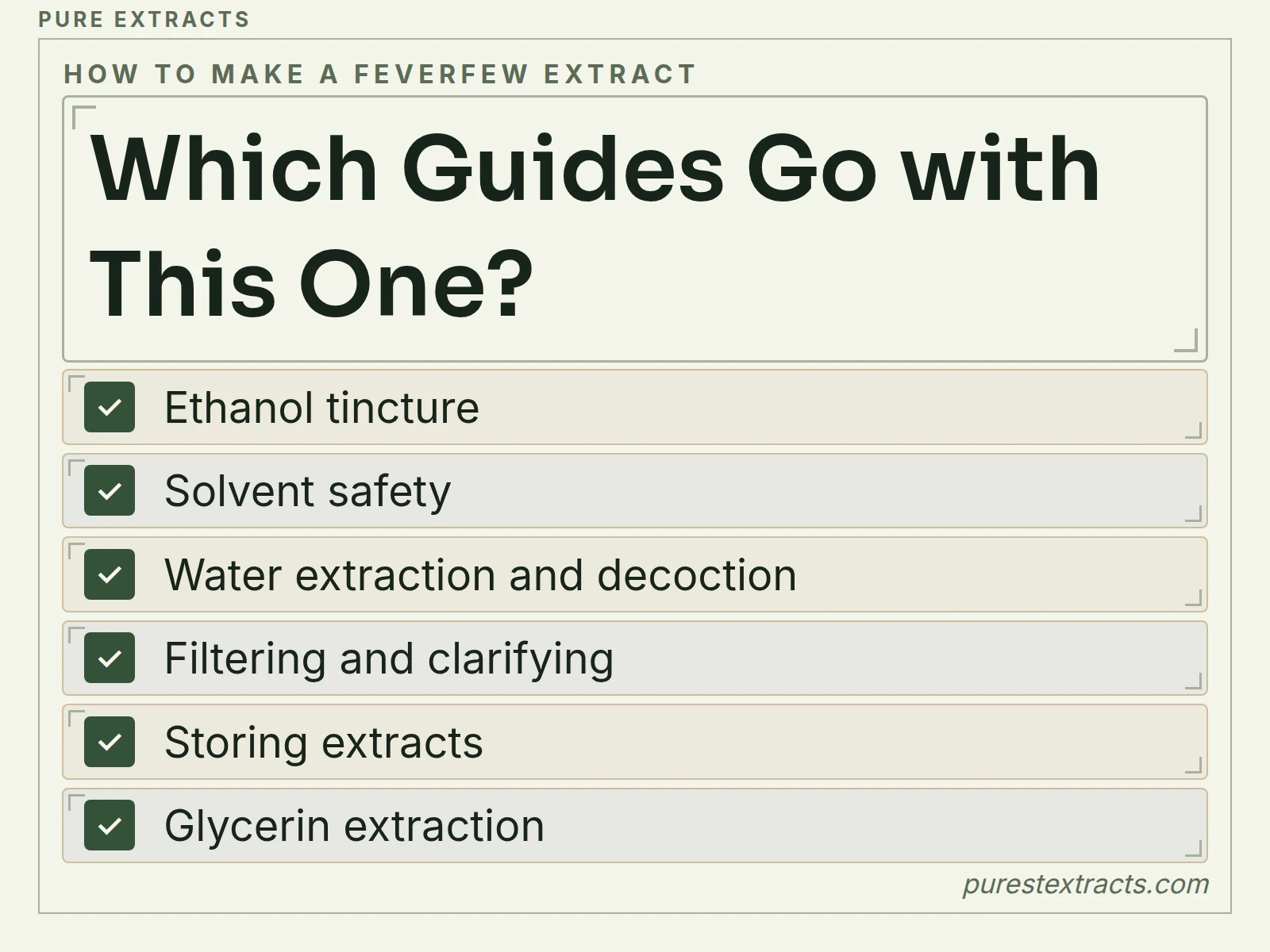
Which guides go with this one?
- Ethanol tincture
- Solvent safety
- Water extraction and decoction
- Filtering and clarifying
- Storing extracts
- Glycerin extraction
- Oil infusion
- Drying herbs
- Choosing a method
Sources
- migraine, Feverfew significantly reduced migraine attack frequency (IV: -1.11 -1.23 to -0.99, p < 0.00001; I2 = 28%), migraine duration (IV: -4.43 -7
- Herbal treatments for migraine: A systematic review of randomised-controlled studies (2020)
- Comparison of the Effect of Tanacethum Parthenium, 5-Hydroxy Tryptophan, and Magnesium (Aurastop) versus Magnesium Alone on Aura Phenomenon and Its Ev (2019)
- A Critical Approach to Evaluating Clinical Efficacy, Adverse Events and Drug Interactions of Herbal Remedies (2016)
- The combined effect of acupuncture and Tanacetum parthenium on quality of life in women with headache: randomised study (2012)
- Anti-inflammatory activity of parthenolide-depleted Feverfew (Tanacetum parthenium) (2009)
- Evaluation of the Antihistamine and Anti-Inflammatory Effects of a Nutraceutical Blend Based on Quercetin, Perilla frutescens, Boswellia serrata, Blac (2025)
- Chemical Composition of Extracts from Various Parts of Feverfew (Tanacetum parthenium L.) and Their Antioxidant, Protective, and Antimicrobial Activit (2024)
- TRADITIONAL Cherokee (Native American) - Orthopedic -- Aid Infusion used to bathe swollen feet. Hamel, Paul B. and Mary U. Chiltoskey, 1975,
- TRADITIONAL Documented medicinal use - Antiecchymotic Antiinflammatory Antirheumatic Antispasmodic Aperient Bitter Carminative Emmenagogue S
- TRUSTED general - Preparation: Many users take the fresh leaf at a maximum dosage of 2g. Side effects are uncommon, however eating the fresh
- TRUSTED migraine headaches - A few studies support this use. Post-feverfew withdrawal syndrome (consisting of muscle stiffness, anxiety, hea
Common questions
What are you extracting from feverfew?
Feverfew ( Tanacetum parthenium ) yields a complex chemical profile, making solvent choice critical. The plant is rich in sesquiterpene lactones, with parthenolide being the principal marker; dried leaves can contain up to 1% of this compound. Other phytochemicals include camphor, luteolin and apigenin. Because parthenolide content varies substantially, by more than 40-fold, standardization is challenging despite labeling claims. It’s important to note that feverfew leaf lacking parthenolide has not been clinically tested for migraine prophylaxis.
Which extraction method suits feverfew, and why?
Feverfew’s chemical profile dictates the best approach to extraction. The plant contains sesquiterpene lactones - notably parthenolide - flavonoids, and other compounds. These vary in polarity, but the primary target, parthenolide, is present in concentrations as high as 1% in dried leaves, demanding a solvent capable of efficient recovery. [ethanol tincture] is the most suitable method. The table shows that a 60-70% ethanol solution with 30-40% water suits alkaloids and glycosides; feverfew contains both.
What solvent and ratio should you use for feverfew?
Feverfew’s active compounds include sesquiterpene lactones like parthenolide and flavonoids. To extract these effectively, an ethanol tincture is the preferred method. The plant is chemically complex, requiring a solvent that can capture a broad range of metabolites. The table shows several ethanol percentages suited to different herb types; feverfew falls into the category best served by a 40-50% ethanol solution with 50-60% water. This ratio targets flavonoids and phenolics, present in feverfew alongside its key sesquiterpenes.
How do you make a feverfew extract step by step?
Feverfew extracts require careful consideration of the plant’s chemistry and desired outcome. The plant is chemically complex, containing sesquiterpene lactones like parthenolide as key constituents. Because commercially available feverfew supplements vary substantially in parthenolide content, by more than 40-fold, accurate extraction is important. [ethanol tincture] is a common method for feverfew, offering good extraction of the plant’s diverse compounds. Begin with thoroughly [drying herbs].
Who should be careful with feverfew?
Feverfew presents cautions for several groups. Anyone on blood-thinning medication should exercise care, as feverfew exhibits [STUDY] antiplatelet activity. This means it may increase the risk of bleeding. Individuals scheduled for surgery must discontinue use at least one to two weeks prior to the procedure, again due to its effect on platelet function. Pregnancy and breastfeeding are absolute contraindications.
How do you store a feverfew extract, and how long does it keep?
Feverfew extracts require careful storage to maintain potency. The ideal conditions depend on the solvent used during creation. [storing extracts] covers general principles, but feverfew has specifics due to its chemical profile. Alcohol tinctures, made with ethanol percentages ranging from 25% to 95%, are the most stable. Use food-grade ethanol only; denatured alcohol is unsuitable.
What are related guides?
Plants Activated Charcoal Production Plants Adaptogenic Compounds Plants Oregano, Medicinal Applications . How botanical extracts are made, step by step, from the people who run the extractions. What we learn, sent about once a week. All guides Ebooks Courses Free extras . About Contact Privacy Terms .
Browse by topic
More guides to explore
 ExtractionCold Press Extraction
 ExtractionEnzymatic Extraction
 ExtractionEthanol Extraction
 ExtractionMicrowave-Assisted Extraction
 ExtractionNatural Dye Extraction and Use
 ExtractionPressurized Hot Water Extraction
 ExtractionSteam Distillation