Plants
How to Make a Maca Extract: Methods, Solvents and Shelf Life
Which parts of maca to use, which method pulls out its compounds, the solvent and ratio, safety and how long the extract keeps.
On this page
What are you extracting from maca?
Maca root contains several key bioactive compounds targeted during extraction, most notably macamides and macaenes. Alongside these signature molecules are glucosinolates and alkaloids, all contributing to the plant’s complex activity. Macamides, formed by benzylamine and a fatty acid, vary in chain length and saturation. Critically, these are largely created during drying herbs; they are essentially absent from fresh root but can reach up to 800 μg g−1 dry wt in traditionally dried hypocotyls or those oven-dried industrially. Maca’s composition is variable, influenced by ecotype, growth conditions and post-harvest processing.
Extraction choices depend on the desired compounds. For a broad spectrum of maca's phytochemical profile, macamides, macaenes, glucosinolates, an ethanol tincture using 40-50% ethanol with 50-60% water is appropriate. This percentage covers flavonoids, phenolics and most general-purpose herbs. A 60-70% ethanol solution with 30-40% water would also work well for alkaloids and glycosides. Higher percentages, like 90-95% ethanol with 5-10% water, are better suited to resins and volatile oils but may not capture the full range of maca constituents.
Glycerin glycerin extraction is an option for alcohol-sensitive applications, though it extracts fewer compounds and results in a lower potency product with a shorter shelf life (1-2 years). It will not be equivalent to an ethanol extract.
Regardless of solvent choice, food-grade ethanol must be used; denatured alcohols are toxic. After extraction, filtering and clarifying is essential before storing extracts. If using ethanol, evaporating solvent may be necessary for specific applications. The final product should always adhere to strict solvent safety protocols.
How to Choose an Extraction Method for Any Herb
Match the method to the plant: what polarity and heat sensitivity mean, and which solvent pulls out which compounds.
For a More In-Depth Read, Click HereWhich extraction method suits maca, and why?
Maca’s complex chemistry requires careful consideration when [choosing a method]. Its bioactive compounds include macamides, macaenes, glucosinolates and alkaloids - a mix demanding an extraction solvent with broad capabilities. Maca's composition varies significantly based on phenotype, origin, and processing, meaning a flexible approach is best.
Given the established importance of macamides, and their formation during drying, understanding post-harvest handling is critical before extraction even begins [drying herbs]. Analyses show these signature compounds are essentially absent from fresh root but can reach up to 800 μg g−1 dry wt in traditionally or oven-dried material.
An ethanol tincture offers the most comprehensive approach. Maca’s alkaloids, glycosides and bitters respond well to a solvent between 60-70% ethanol. This percentage balances extraction efficiency with minimizing co-extraction of unwanted compounds. A 50-60% ethanol solution would also be suitable for extracting flavonoids and phenolics, covering much of maca's phytochemical profile. Using food-grade ethanol is essential; denatured alcohol is unacceptable [solvent safety].
Vodka (40% ethanol / 80 proof) may work for some compounds but isn’t adjustable and lacks the power to extract resins effectively. Glycerin extraction [/articles/glycerin-extraction] is less effective overall, yielding lower potency and a shorter shelf life of one to two years compared to alcohol tinctures which can last five or more [storing extracts]. Water extraction [/articles/extraction-water] would primarily target polar molecules, missing key constituents like the macamides.
Following extraction, proper filtering and clarifying is necessary before safe storage. If solvent is used, evaporating solvent must be done carefully to concentrate the extract.
How to Make a Glycerite: Glycerin Herbal Extracts
The alcohol-free extract: which herbs suit vegetable glycerin, how much water to add, how to make it and how long it keeps.
For a More In-Depth Read, Click HereWhat solvent and ratio should you use for maca?
Maca’s complex phytochemical profile, macamides, macaenes, glucosinolates, and alkaloids, requires careful solvent selection for effective extraction. Considering the active compounds and traditional use, an ethanol tincture is appropriate.
The composition of maca varies by phenotype and processing, so a broad-spectrum approach is best. Macamides, critical to maca’s activity, are largely formed during drying and not present in fresh root. This means extraction targets dried material.
A ratio of 60-70% ethanol with 30-40% distilled water is suitable for extracting alkaloids, most glycosides, and bitters found in maca. This falls within the range for general-purpose herbs as well. Use food-grade ethanol only; denatured alcohol is unacceptable due to toxicity. Starting with 190 proof / 95% ethanol and diluting it to target percentage with distilled water allows precise control. Vodka (40% ethanol) is inadequate because its strength cannot be adjusted.
The table indicates this ratio suits herbs like echinacea, chamomile, passionflower, and valerian - plants sharing some compound classes with maca.
Glycerin glycerin extraction extracts fewer compounds than ethanol and would not be a direct substitute for an alcohol tincture. Apple cider vinegar or oil infusions are unsuitable given the target compounds. CO2 extraction is possible but requires specialized equipment. Water extraction alone will not capture the full range of desired constituents.
Proper drying herbs is essential before beginning, as macamides develop during this process. After extraction, filtering and clarifying removes particulate matter. Store finished tinctures properly for a shelf life of 5+ years storing extracts.
How do you make a maca extract step by step?
Maca extracts begin with properly prepared plant material. drying herbs is critical because macamides, key bioactives, form during this process and are absent from fresh root. Maca’s composition varies by origin and processing, so consistent starting material matters.
An ethanol tincture is a common extraction method for maca, offering broad-spectrum results. ethanol tincture allows adjusting the alcohol percentage to suit target compounds. For maca, consider 60-70% ethanol with 30-40% distilled water, good for alkaloids and glycosides present in the root. Use only food-grade ethanol; denatured alcohol is unsafe. Everclear or organic grape alcohol can be diluted from a starting point of 90-95% ethanol.
Combine dried maca root with the chosen solvent in a clean jar. A typical ratio isn’t specified, but ensure complete submersion of plant material. Seal tightly and store in a cool, dark place for several weeks, shaking daily to maximize extraction.
After sufficient time, filtering and clarifying removes the spent plant matter. Multiple filtration stages with increasingly fine filters are best.
evaporating solvent concentrates the extract if a stronger product is desired. This step requires caution and proper ventilation due to ethanol’s flammability; solvent safety must be prioritized. Gentle heat can aid evaporation, but avoid excessive temperatures that could degrade compounds.
Alternatively, a glycerin extraction is possible using 60% glycerin and 40% water, though potency will be lower than an ethanol tincture. This method avoids alcohol entirely.
Finally, store the finished extract in airtight amber glass bottles away from light and heat. storing extracts properly ensures a shelf life of five years or more for alcohol tinctures.
Who should be careful with maca?
Maca presents few reported risks, but certain individuals should exercise caution. Maca’s effects on hormone levels are complex; clinical studies show no significant differences in testosterone or estradiol versus placebo even when assessing fertility, but anyone with hormone-sensitive conditions should start slowly and monitor for changes. This includes those with estrogen-, progesterone-, or androgen-dependent conditions.
Traditional use notes maca as an aphrodisiac, enhancing sexual drive, but this is based on folk belief. Those taking medications affecting libido should be aware of potential interactions, even if the mechanism appears non-hormonal in studies.
Maca’s safety profile is generally good with rare adverse effects reported in preclinical studies, however those with thyroid conditions need to be cautious. Maca contains glucosinolates; compounds also found in cruciferous vegetables. These can interfere with iodine uptake and potentially exacerbate hypothyroidism.
Digestive upset is possible, particularly at higher doses. Starting with a low dose and gradually increasing it may minimize discomfort. Typical dosages in human studies range from 1.5-3 g/day over 8-12 weeks.
Those considering [ethanol tincture] or other solvent-based extractions should be aware of [solvent safety]. Food-grade ethanol is essential; denatured alcohol is not acceptable. If choosing a different method, consider that glycerin extracts ([glycerin extraction]) have lower potency and shorter shelf lives (1-2 years versus 5+ years for alcohol tinctures). A [water extraction and decoction] might be suitable if avoiding alcohol entirely, but will extract a different range of compounds than ethanol which covers a broad range.
Proper [drying herbs] is critical as macamides, the signature bioactive class, are largely formed during drying and absent in fresh root. Post-harvest processing significantly impacts chemical composition; variations occur due to ecotypes and growth conditions. Careful attention to detail throughout extraction and [storing extracts] will help maintain potency.
Before any solvent work: use glass or stainless steel rated for the solvent, work outdoors or beside a fan pulling the vapor away from you, heat ethanol only on an electric or induction hot plate (never an open flame or a gas burner), and do not breathe solvent vapor. This guide is education, not medical advice: check with a doctor before using any herbal extract alongside medication, during pregnancy or for a child.
How do you store a maca extract, and how long does it keep?
Maca extracts benefit from careful storage to maintain potency. The ideal conditions depend on the solvent used during production. An ethanol tincture - made with alcohol percentages ranging from 25% to 95%, depending on target compounds - will last five or more years if stored correctly. Keep it in a dark glass bottle, tightly sealed, away from heat and light.
A glycerin extraction, while suitable for some applications, has a shorter shelf life of one to two years. Glycerine’s viscosity and composition yield lower potency than alcohol, so storage is even more critical. Store glycerites similarly: dark glass, sealed, cool and dark.
Other methods influence stability. An oil infusion will be susceptible to rancidity; refrigeration extends its life but does not guarantee it. Water extracts require immediate processing - typically drying via drying herbs or freeze-drying - as they are prone to microbial growth.
Regardless of the method, protect your maca extract from temperature fluctuations. Consistent cool storage is best. Avoid direct sunlight and humidity. Proper storing extracts preserves the macamides, macaenes, glucosinolates, and alkaloids present in the original material.
Remember that composition varies by phenotype, origin, and processing; a well-made extract from high-quality root will naturally retain potency longer than one made with substandard material. Finally, always practice solvent safety when handling any extraction solvent, even diluted ethanol.
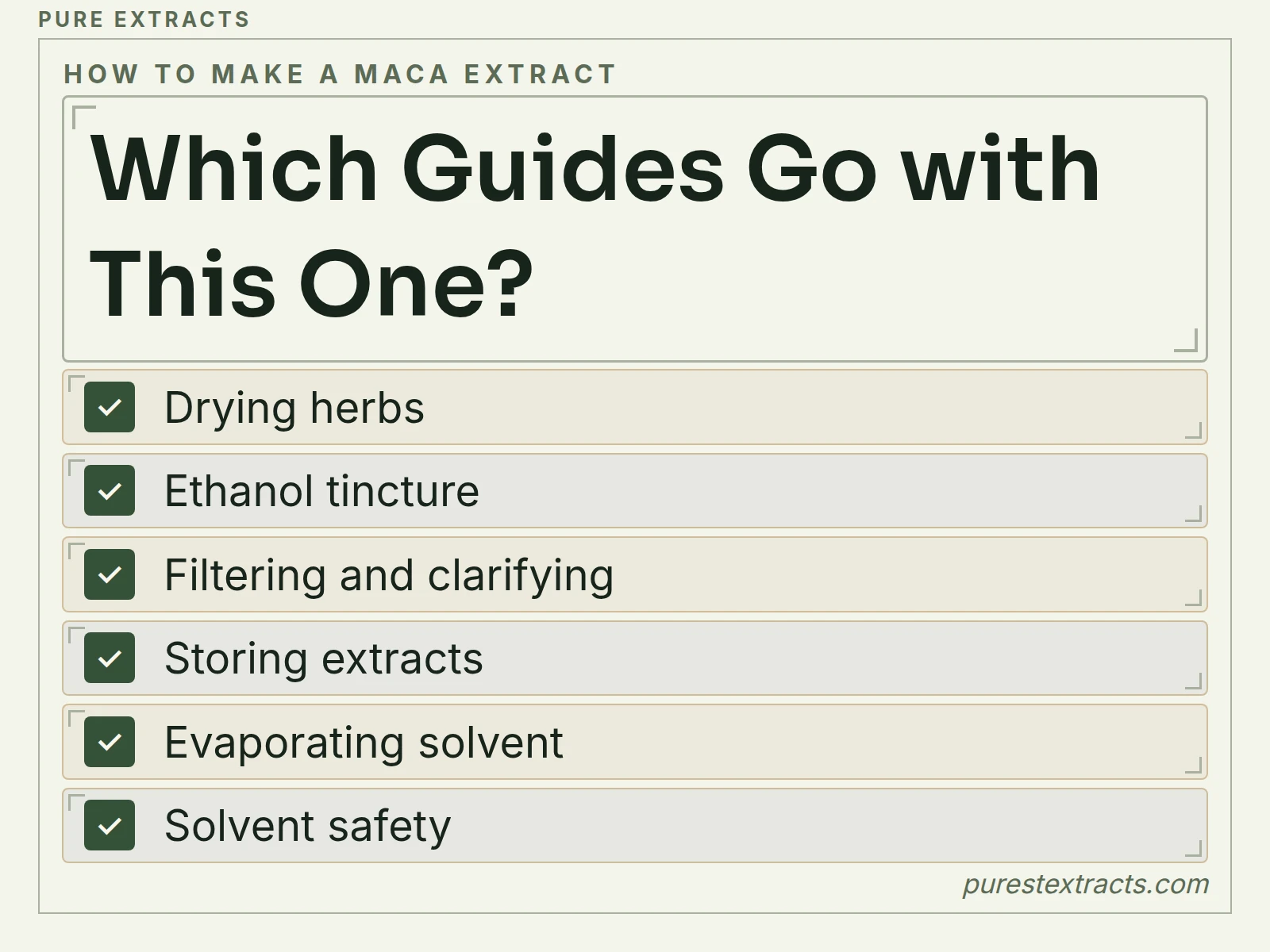
Which guides go with this one?
- Drying herbs
- Ethanol tincture
- Filtering and clarifying
- Storing extracts
- Evaporating solvent
- Solvent safety
- Glycerin extraction
- Oil infusion
- Choosing a method
How to Filter and Clarify an Extract: Carbon, Bentonite and Silica
From coarse straining to fine filters, and how activated carbon, bentonite clay and silica clean up an extract.
For a More In-Depth Read, Click HereSources
- womens libido, ITT subjects on 3.0 g/day maca had a significant improvement in ASEX (from 22.8+/-3.8 to 16.9+/-6.2; z=-2.20, P=0.028) and in MGH-SFQ
- menopause, MMP-1 showed substantially increase mRNA expression in MDA-MB-231 by 86-fold and in Hs578T by 5-fold. (
- LAB/ANIMAL menopause, RESULT: Our findings showed that red and black maca extracts significantly (P < .001) reduced the MDA level in OVX rat serum un
- LAB/ANIMAL weight gain, The addition of 2.0 g/kg of maca powder to the diet significantly decreased body weight, body weight gain compared to the con
- The efficacy of herbal medicines on anxiety and depression in peri- and postmenopausal women: A systematic review and meta-analysis (2019)
- Maca reduces blood pressure and depression, in a pilot study in postmenopausal women (2015)
- Medicinal plants as alternative treatments for female sexual dysfunction: utopian vision or possible treatment in climacteric women? (2010)
- Global Research Status of Maca (Lepidium Meyenii Walp.): A Bibliometric Analysis of Hotspots, Bursts, and Trends (2025)
- TRADITIONAL Isleta (Native American) - Analgesic -- Leaves chewed for headaches. Jones, Volney H., 1931, The Ethnobotany of the Isleta India
- TRADITIONAL Documented medicinal use - Adaptogen Aphrodisiac Cancer Infertility Nutritive Tonic Maca is a little known herbal remedy and hig
- TRUSTED general - Preparation: Powdered herb: approximately 70-85 g per week, depending on one’s size Plant parts used Root (Herbal Reality
- MSK About Herbs ,
Common questions
What are you extracting from maca?
Maca root contains several key bioactive compounds targeted during extraction, most notably macamides and macaenes. Alongside these signature molecules are glucosinolates and alkaloids, all contributing to the plant’s complex activity. Macamides, formed by benzylamine and a fatty acid, vary in chain length and saturation. Critically, these are largely created during drying herbs ; they are essentially absent from fresh root but can reach up to 800 μg g−1 dry wt in traditionally dried hypocotyls or those oven-dried industrially.
Which extraction method suits maca, and why?
Maca’s complex chemistry requires careful consideration when [choosing a method]. Its bioactive compounds include macamides, macaenes, glucosinolates and alkaloids - a mix demanding an extraction solvent with broad capabilities. Maca's composition varies significantly based on phenotype, origin, and processing, meaning a flexible approach is best. Given the established importance of macamides, and their formation during drying, understanding post-harvest handling is critical before extraction even begins [drying herbs].
What solvent and ratio should you use for maca?
Maca’s complex phytochemical profile, macamides, macaenes, glucosinolates, and alkaloids, requires careful solvent selection for effective extraction. Considering the active compounds and traditional use, an ethanol tincture is appropriate. The composition of maca varies by phenotype and processing, so a broad-spectrum approach is best. Macamides, critical to maca’s activity, are largely formed during drying and not present in fresh root. This means extraction targets dried material.
How do you make a maca extract step by step?
Maca extracts begin with properly prepared plant material. drying herbs is critical because macamides, key bioactives, form during this process and are absent from fresh root. Maca’s composition varies by origin and processing, so consistent starting material matters. An ethanol tincture is a common extraction method for maca, offering broad-spectrum results. ethanol tincture allows adjusting the alcohol percentage to suit target compounds.
Who should be careful with maca?
Maca presents few reported risks, but certain individuals should exercise caution. Maca’s effects on hormone levels are complex; clinical studies show no significant differences in testosterone or estradiol versus placebo even when assessing fertility, but anyone with hormone-sensitive conditions should start slowly and monitor for changes. This includes those with estrogen-, progesterone-, or androgen-dependent conditions. Traditional use notes maca as an aphrodisiac, enhancing sexual drive, but this is based on folk belief.
How do you store a maca extract, and how long does it keep?
Maca extracts benefit from careful storage to maintain potency. The ideal conditions depend on the solvent used during production. An ethanol tincture - made with alcohol percentages ranging from 25% to 95%, depending on target compounds - will last five or more years if stored correctly. Keep it in a dark glass bottle, tightly sealed, away from heat and light. A glycerin extraction , while suitable for some applications, has a shorter shelf life of one to two years.
What are related guides?
Plants Activated Charcoal Production Plants Adaptogenic Compounds Plants Oregano, Medicinal Applications . How botanical extracts are made, step by step, from the people who run the extractions. What we learn, sent about once a week. All guides Ebooks Courses Free extras . About Contact Privacy Terms .
Browse by topic
More guides to explore
 ExtractionCold Press Extraction
 ExtractionEnzymatic Extraction
 ExtractionEthanol Extraction
 ExtractionMicrowave-Assisted Extraction
 ExtractionNatural Dye Extraction and Use
 ExtractionPressurized Hot Water Extraction
 ExtractionSteam Distillation