Plants
How to Make a Yarrow Extract: Methods, Solvents and Shelf Life
Which parts of yarrow to use, which method pulls out its compounds, the solvent and ratio, safety and how long the extract keeps.
On this page
What are you extracting from yarrow?
Yarrow (Achillea millefolium) yields an array of compounds depending on the chosen method. We extract essential oil, sesquiterpene lactones like matricin and achillicin, flavonoids including apigenin, luteolin, quercetin and rutin, phenolic acids such as gallic acid and caffeic acid, plus tannins. The essential oil content ranges roughly from 0.2-1.4%. Steam distillation concentrates the volatile components, potentially yielding an oil with up to 50 percent chamazulene depending on the plant’s chemotype; chamazulene isn't present in fresh yarrow but forms during this process and imparts a deep blue color.
Extraction choices depend on target compounds. For broad-spectrum extraction covering most flavonoids and phenolics, an ethanol tincture using 40-50% ethanol with 50-60% water is suitable. This method works well for general-purpose herbs. Alkaloids and bitters benefit from a stronger 60-70% ethanol solution with 30-40% water. Resins and volatile oils require 90-95% ethanol with only 5-10% water. [ethanol tincture] is a common starting point, but remember to use food-grade alcohol only; [solvent safety] is paramount.
Glycerin extraction ([glycerin extraction]) offers an alcohol-free alternative using a typical 60% glycerin / 40% water ratio, though potency and shelf life (1-2 years) are reduced compared to alcohol tinctures. Tannins and saponins respond well to this method. For mineral-rich preparations, apple cider vinegar can be used but is not a general replacement for ethanol.
After extraction, [filtering and clarifying] removes particulate matter. Solvent removal requires careful attention; [evaporating solvent] must occur at appropriate temperatures to preserve delicate compounds. Proper [storing extracts] in airtight containers protects against degradation. Consider that most mechanistic data are in vitro or animal studies - robust human clinical confirmation is limited.
Which extraction method suits yarrow, and why?
Yarrow’s chemical profile dictates the best approach to extraction. Its constituents include essential oil (0.2-1.4%), sesquiterpene lactones, flavonoids, phenolic acids and tannins. These compounds vary in polarity, requiring consideration when [choosing a method].
A 60-70% ethanol solution is well suited for yarrow. This ratio effectively extracts alkaloids, most glycosides, and bitters present within the plant material. Yarrow contains sesquiterpene lactones such as matricin which are best captured with this percentage of alcohol. The monograph details that chamazulene forms during steam distillation, but a tincture allows capture of a broader range of compounds beyond just the volatile oil.
While a 40-50% ethanol solution could extract flavonoids and phenolics, it risks leaving behind some of the more potent constituents. Vodka (40% ethanol) is inadequate for full extraction as it cannot be adjusted to target higher alcohol percentages. Glycerin extraction offers an alternative, but yields lower potency and isn’t equivalent to an alcohol tincture. It also has a shorter shelf life - 1-2 years versus over 5+ years for alcohol tinctures.
Water extraction and decoction would primarily capture polar compounds like tannins, resulting in an astringent extract lacking the full spectrum of yarrow's benefits. CO2 extraction targets non-polar molecules; while useful for some plants, it wouldn’t be ideal given yarrow's diverse chemical makeup.
Proper preparation includes using food-grade ethanol and diluting to the target percentage with distilled water. Following these guidelines ensures a standardized extract comparable to those historically produced by pharmacies following the United States Pharmacopeia methods.
What solvent and ratio should you use for yarrow?
Yarrow’s complex chemistry requires careful solvent selection for effective extraction. Its constituents include flavonoids, phenolic acids, sesquiterpene lactones, and an essential oil - all influencing which method to use. Considering these compounds, an ethanol tincture is appropriate [ethanol tincture].
The monograph details several ethanol percentages suited to different plant chemistries. Yarrow falls into the category of herbs best extracted with 40-50% ethanol in 50-60% water. This ratio targets flavonoids and phenolics, both abundant in yarrow, as well as its other constituents. A 60-70% ethanol / 30-40% water mix is also suitable for extracting alkaloids and bitters like those found in yarrow’s sesquiterpene lactones.
Use food-grade ethanol only; denatured alcohol is unsafe [solvent safety]. Begin with a high-proof source, such as Everclear (190 proof / 95% ethanol) or organic grape alcohol, then dilute to the target percentage using distilled water. Vodka at 40% ethanol can work for leaves and flowers but lacks adjustability.
Traditional tincture preparation, codified by the United States Pharmacopeia, emphasizes standardization. While folk methods are accessible, they sacrifice precision. Proper drying of herbs is essential before extraction [drying herbs]. After extraction, filtering and clarifying will remove particulate matter [filtering and clarifying], followed by appropriate storage to maintain potency [storing extracts].
Glycerin or vinegar extractions aren’t ideal for yarrow. Glycerin's lower extraction efficiency would limit yield [glycerin extraction] and an apple cider vinegar extract wouldn't capture the full spectrum of compounds. Steam distillation can isolate the essential oil, yielding roughly 0.2-1.4% by weight [steam distillation], but misses the non-volatile constituents.
How to Choose an Extraction Method for Any Herb
Match the method to the plant: what polarity and heat sensitivity mean, and which solvent pulls out which compounds.
For a More In-Depth Read, Click HereHow do you make a yarrow extract step by step?
Yarrow extracts begin with properly prepared plant material. Begin by drying herbs the aerial parts when in flower for best results. Extraction method selection depends on desired compounds and end use; review choosing a method.
For a traditional alcohol tincture, select food-grade ethanol. A ratio of 60-70% ethanol to 30-40% distilled water suits yarrow’s alkaloids, glycosides and bitters well. Use 95% ethanol diluted with water if targeting resins or volatile oils; this requires careful calculation. Alternatively, a simpler approach uses 80 proof vodka, though it lacks adjustability.
Combine dried yarrow with the chosen solvent in a clean glass jar. A typical ratio is not specified in our resources but standardization relies on precise measurement. Ensure plant material is fully submerged. Seal tightly and store in a cool, dark place for several weeks, shaking regularly.
For a glycerin extract glycerin extraction, use a 60% glycerin / 40% water mixture. Glycerin extracts are less potent than alcohol tinctures and have a shorter shelf life (1-2 years).
After maceration, separate the liquid from plant matter using filtering and clarifying. Multiple layers of cheesecloth or a fine mesh strainer work for smaller batches.
If concentrating an ethanol extract, proceed with caution and review solvent safety before attempting evaporating solvent. Store finished extracts in airtight, dark glass bottles at cool temperatures storing extracts. Alcohol tinctures have a shelf life of 5+ years.
Yarrow contains compounds like chamazulene which forms during steam distillation steam distillation and is not present in the fresh plant, yielding an essential oil essential oils. This method requires specialized equipment.
Who should be careful with yarrow?
Yarrow (Achillea millefolium) presents specific cautions for certain individuals due to its biochemical activity and documented uses. Anyone taking medications should exercise care. Chamazulene, found in yarrow essential oil, interferes with major human drug-metabolizing enzymes. It interacts with drugs metabolized by these enzymes including estrogens, estradiol, acetaminophen, codeine, erythromycin, diazepam, and cyclosporine.
Individuals with bleeding disorders or those taking anticoagulant medications should avoid yarrow. Its traditional use centers on hemostatic action, promoting blood clotting, attributed to achilleine. While primarily demonstrated in vitro, this effect poses a risk for anyone prone to excessive clotting or already managing coagulation with pharmaceuticals.
People with allergies within the Asteraceae/Compositae family (ragweed, marigolds, daisies) may experience cross-reactivity.
Pregnant and breastfeeding individuals should avoid yarrow due to limited safety data. While traditionally used to support women’s health, robust clinical confirmation is lacking. The potential for uterine stimulation or effects on lactation remains unknown.
Those with autoimmune conditions require caution. Yarrow's immune-stimulating properties could exacerbate symptoms in some cases.
When preparing extracts, consider solvent choice carefully. A ethanol tincture using 60-70% ethanol and 30-40% water is suitable for alkaloids, glycosides, and bitters. For flavonoid and phenolic extraction, a 40-50% ethanol solution with 50-60% water works well. Avoid glycerin extraction if seeking potency comparable to alcohol extracts; glycerites have shorter shelf lives (1-2 years) and lower overall extraction rates. Steam distillation yields essential oil, roughly 0.2-1.4% of the plant mass, containing chamazulene which varies dramatically by chemotype, some yarrow yielding none at all, others exceeding 50 percent concentration. Proper solvent safety is paramount when using ethanol; use food-grade alcohol only.
Before any solvent work: use glass or stainless steel rated for the solvent, work outdoors or beside a fan pulling the vapor away from you, heat ethanol only on an electric or induction hot plate (never an open flame or a gas burner), and do not breathe solvent vapor. This guide is education, not medical advice: check with a doctor before using any herbal extract alongside medication, during pregnancy or for a child.
How to Make a Glycerite: Glycerin Herbal Extracts
The alcohol-free extract: which herbs suit vegetable glycerin, how much water to add, how to make it and how long it keeps.
For a More In-Depth Read, Click HereHow do you store a yarrow extract, and how long does it keep?
Yarrow extracts require careful storage to maintain potency. The ideal conditions depend on the solvent used during creation. Alcohol tinctures, made with between 40% and 95% ethanol, are stable for five years or more if stored correctly. Keep them in dark glass bottles, tightly sealed, away from heat and light. A cool, dark place is best; refrigeration isn’t necessary but won't harm it.
Glycerin extracts, created via glycerin extraction, have a shorter shelf life of one to two years. These also need dark glass bottles and protection from heat and light. Glycerin’s higher water content makes it more susceptible to microbial growth over time.
Extracts made with vinegar, an acetract, last six to twelve months refrigerated. This method is best for mineral-rich herbs, not general use.
Regardless of the solvent, protect your extract from oxidation. Exposure to air degrades many plant compounds. Ensure bottles are fully sealed after each use. Consider purging headspace with an inert gas like nitrogen before sealing for long-term storage, though this isn’t essential for home production.
Proper drying herbs prior to extraction is crucial; any residual moisture will shorten the extract's lifespan. A well-made tincture following United States Pharmacopeia standards, using ratios detailed in the historical method, will be more stable than a quickly made folk preparation.
Always inspect an extract before use. Discard if you see signs of mold, cloudiness, or unusual odor. Following these guidelines preserves your yarrow’s beneficial compounds for extended use. Refer to storing extracts for more detailed information on preservation techniques.
How to Filter and Clarify an Extract: Carbon, Bentonite and Silica
From coarse straining to fine filters, and how activated carbon, bentonite clay and silica clean up an extract.
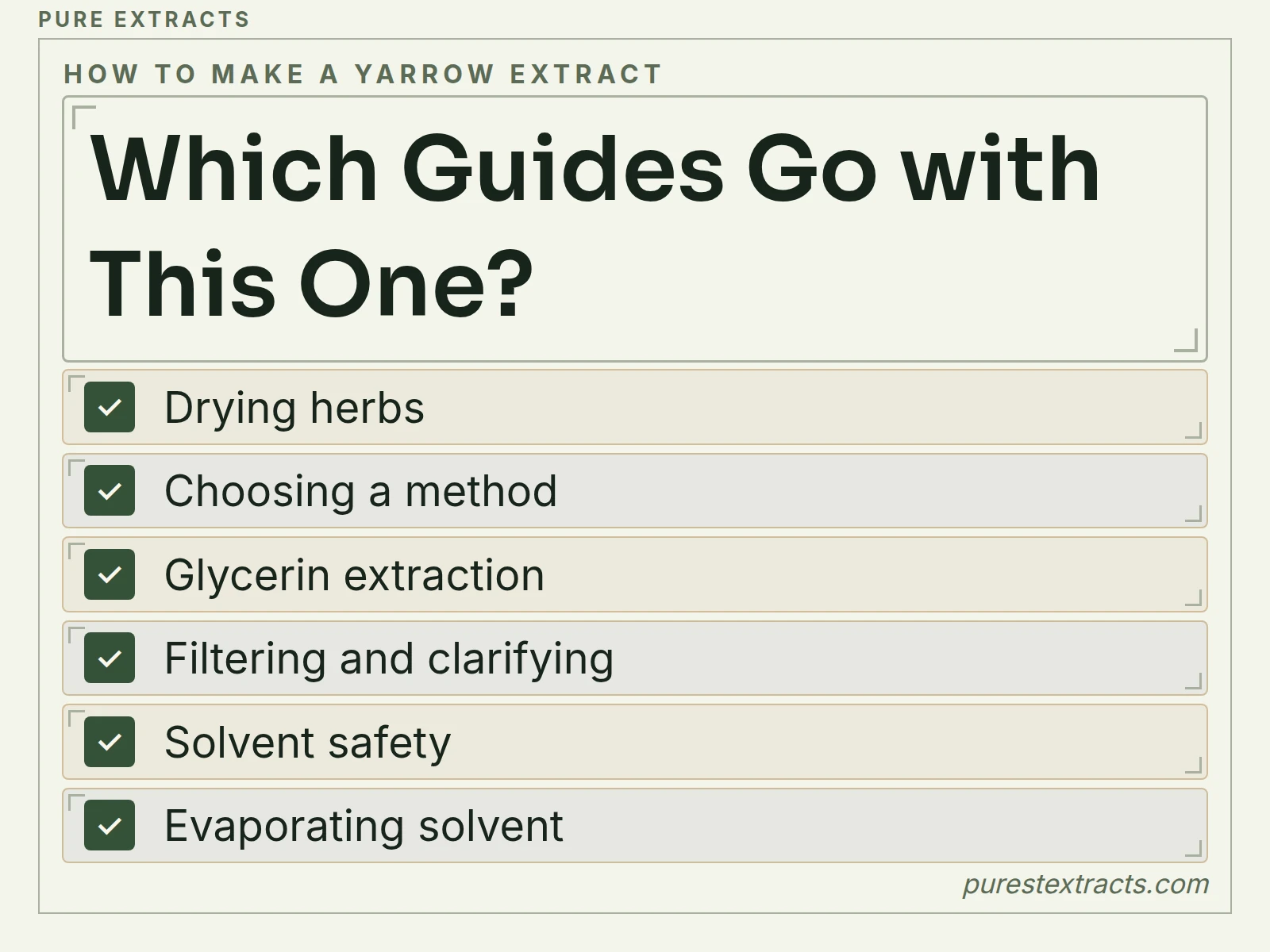
For a More In-Depth Read, Click HereWhich guides go with this one?
- Drying herbs
- Choosing a method
- Glycerin extraction
- Filtering and clarifying
- Solvent safety
- Evaporating solvent
- Storing extracts
- Steam distillation
- Essential oils
- Ethanol tincture
Sources
- LAB/ANIMAL skin, In tyrosinase assays, AFiv extracts were the most potent, inhibiting murine tyrosinase by 56.8 - 62.8% and human tyrosinase by 17.6
- LAB/ANIMAL skin, The hydroalcholic (EtOH50 %) extracts were quali-quantitatively characterized by HPLC-PDA-MS/MS and tested for their inhibitory effe
- Efficacy and safety of a standardized extract from Achillea wilhelmsii C. Koch in patients with ulcerative colitis: A randomized double blind placebo- (2019)
- The estimation of the traditionally used yarrow (Achillea millefolium L. Asteraceae) oil extracts with anti-inflamatory potential in topical applicati (2017)
- Surface rejuvenating effect of Achillea millefolium extract (2011)
- Antiulcerogenic activity of hydroalcoholic extract of Achillea millefolium L.: Involvement of the antioxidant system (2010)
- TRADITIONAL Eclectic / European herbal medicine - Yarrow possesses slightly astringent properties, and is tonic, alterative and diuretic, in
- TRADITIONAL Abnaki (Native American) - Cold -- Remedy Infusion of whole plant given to children for colds. Rousseau, Jacques, 1947, Ethnobot
- TRADITIONAL Documented medicinal use - Antidiarrhoeal Antiinflammatory Antiseptic Antispasmodic Appetizer Aromatic Astringent Carminative Ch
- TRUSTED general - Preparation: Tincture (fresh 1:4 in 25%/ dried 1:5 in 25% ): Take between 2-5ml in a little water up to three times a day.
Common questions
What are you extracting from yarrow?
Yarrow ( Achillea millefolium ) yields an array of compounds depending on the chosen method. We extract essential oil, sesquiterpene lactones like matricin and achillicin, flavonoids including apigenin, luteolin, quercetin and rutin, phenolic acids such as gallic acid and caffeic acid, plus tannins. The essential oil content ranges roughly from 0.2-1.4%. Steam distillation concentrates the volatile components, potentially yielding an oil with up to 50 percent chamazulene depending on the plant’s chemotype; chamazulene isn't present in fresh yarrow but forms during this process and imparts a deep blue color.
Which extraction method suits yarrow, and why?
Yarrow’s chemical profile dictates the best approach to extraction. Its constituents include essential oil (0.2-1.4%), sesquiterpene lactones, flavonoids, phenolic acids and tannins. These compounds vary in polarity, requiring consideration when [choosing a method]. A 60-70% ethanol solution is well suited for yarrow. This ratio effectively extracts alkaloids, most glycosides, and bitters present within the plant material.
What solvent and ratio should you use for yarrow?
Yarrow’s complex chemistry requires careful solvent selection for effective extraction. Its constituents include flavonoids, phenolic acids, sesquiterpene lactones, and an essential oil - all influencing which method to use. Considering these compounds, an ethanol tincture is appropriate [ethanol tincture]. The monograph details several ethanol percentages suited to different plant chemistries. Yarrow falls into the category of herbs best extracted with 40-50% ethanol in 50-60% water.
How do you make a yarrow extract step by step?
Yarrow extracts begin with properly prepared plant material. Begin by drying herbs the aerial parts when in flower for best results. Extraction method selection depends on desired compounds and end use; review choosing a method . For a traditional alcohol tincture, select food-grade ethanol. A ratio of 60-70% ethanol to 30-40% distilled water suits yarrow’s alkaloids, glycosides and bitters well.
Who should be careful with yarrow?
Yarrow ( Achillea millefolium ) presents specific cautions for certain individuals due to its biochemical activity and documented uses. Anyone taking medications should exercise care. Chamazulene, found in yarrow essential oil, interferes with major human drug-metabolizing enzymes. It interacts with drugs metabolized by these enzymes including estrogens, estradiol, acetaminophen, codeine, erythromycin, diazepam, and cyclosporine. Individuals with bleeding disorders or those taking anticoagulant medications should avoid yarrow.
How do you store a yarrow extract, and how long does it keep?
Yarrow extracts require careful storage to maintain potency. The ideal conditions depend on the solvent used during creation. Alcohol tinctures, made with between 40% and 95% ethanol, are stable for five years or more if stored correctly. Keep them in dark glass bottles, tightly sealed, away from heat and light. A cool, dark place is best; refrigeration isn’t necessary but won't harm it.
What are related guides?
Plants Activated Charcoal Production Plants Adaptogenic Compounds Plants Oregano, Medicinal Applications . How botanical extracts are made, step by step, from the people who run the extractions. What we learn, sent about once a week. All guides Ebooks Courses Free extras . About Contact Privacy Terms .
Browse by topic
More guides to explore
 ExtractionCold Press Extraction
 ExtractionEnzymatic Extraction
 ExtractionEthanol Extraction
 ExtractionMicrowave-Assisted Extraction
 ExtractionNatural Dye Extraction and Use
 ExtractionPressurized Hot Water Extraction
 ExtractionSteam Distillation